How to Find Winning Dropshipping Products, Then Vet Them
Finding dropshipping product ideas is easy. We read 290 low-star reviews on 10 'winning' products to show how to vet one before you pay for ads.
Finding dropshipping product ideas takes an afternoon: best-seller lists, ad libraries and social feeds will fill a shortlist. Whether an idea makes money depends on three checks per supplier listing: what the 1–3 star reviews say goes wrong, whether you can price below the cheapest store selling the identical item, and whether you can back your ad claims. We ran the review check on 10 products sold as "winners"; the data is public.
Where product ideas come from, and what each source proves
Any of these sources will give you ideas. None of them tells you whether an idea will survive delivery:
| Source | What it proves | What it doesn't |
|---|---|---|
| Marketplace best-seller and "movers" lists | People are buying in this category right now | That your store can sell it at a profit |
| Ad libraries (Meta, TikTok) | Someone is paying to advertise it | That those ads are profitable, or still running next week |
| Viral social posts | The product gets attention | That viewers buy it, or keep it |
| Supplier order and review counts | Recent sales volume on that listing | Product quality, or how many stores already sell it |
Output of this step: 5 to 10 ideas, each tied to one specific supplier listing. Everything below is done per listing, not per product idea, because two listings with the same title can be different products.
What we found when we vetted 10 "winning" products
How we collected the data
On 27 September 2026 we took 10 product types named as winners on Zendrop's winning-products page or as examples in CJdropshipping's guide to finding winning products. Two are near matches rather than the exact product named: Zendrop lists an interactive pet feeder toy, and the closest AliExpress listing we used is a motorised automatic cat toy with no feeder; CJ names a foldable fan, and we used a portable neck fan, an adjacent form factor. For each type we picked the AliExpress listing with the most reviews (at least 25) and read all public reviews the listing showed from the 12 months to 27 September 2026: 3,946 in total. The listings showed nothing older. We then read all 290 reviews at 1, 2 or 3 stars and tagged each one with the problem it describes. The method and codebook, per-listing summary, coded reviews (codes only, no review text) and how each listing was selected are all downloadable.
These are test cases, not recommendations.
Three findings (these 10 listings only)
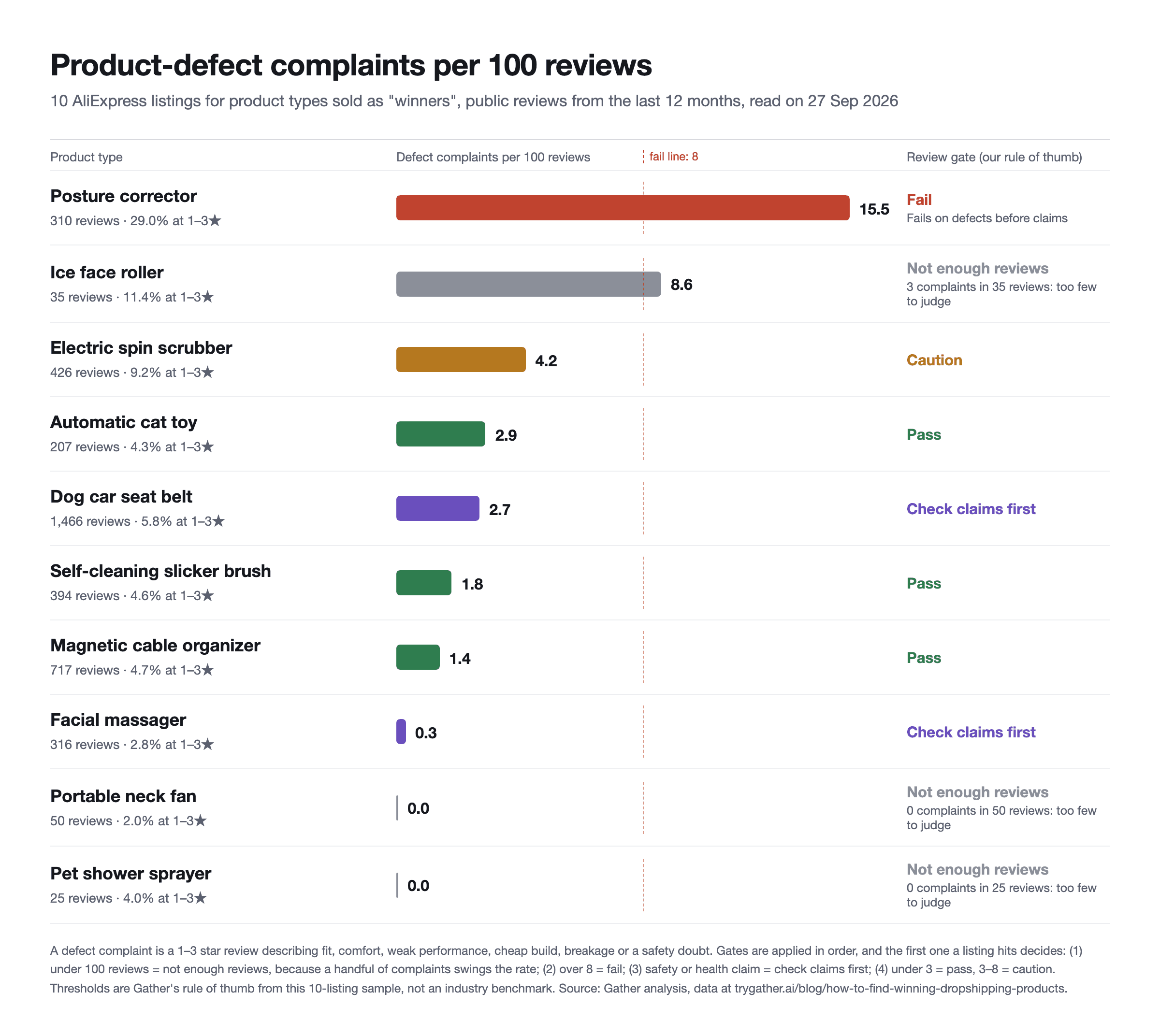
1. The average rating hid the worst product. The posture corrector averaged 4.0 stars. But 29% of its 310 reviews were at 1–3 stars, and 29 of the 58 low-star reviews with text were about fit or comfort: it digs into the armpits, it is one size and too small for broad shoulders, it is too big for a child. That is a design problem, and it recurs.
2. Star counts alone mislead. Of the 171 three-star reviews, 102 (60%) had no text or no identifiable complaint, just "Good" or "Ok". On the dog seat belt it was 32 of 52; on the cable organizer, 24 of 34. Counting every 3-star review as a complaint would have made both look worse than they are.
3. The product, not the shipping, drove the complaints. Of the 191 low-star reviews with text, 133 describe a product problem and six report a wrong or missing item. Only 13 of the 191 mention delivery at all.
Limits
The sample is ten listings, picked by review count, not at random. One person coded every review, reading AliExpress's machine translation where the original was not in English. AliExpress controls which reviews are shown. Only 302 of the 3,946 reviewers were in the US, which matters when you judge sizing complaints for a US store.
Check 1: read the 1–3 star reviews
On the six listings in our sample with 300 or more reviews, there were 9 to 90 reviews at 1–3 stars to read, and many had no text.
- Use the exact listing and variant you would source from. Reviews on a similar listing from another seller describe a different product.
- Filter to 1, 2 and 3 stars using the rating filter in the listing's review panel. Note the total number of reviews and how far back they go.
- Read every review with text. Skip nothing because it looks short. "Strap too short" is two words and a real finding.
- Tag each review with one or more themes: fit or size, comfort, weak or doesn't work, cheap build, arrived broken or died quickly, safety doubt, wrong or missing item, shipping, no complaint, no text.
- Count defect complaints: reviews tagged fit, comfort, weak, cheap build, broken or safety doubt. Divide by total reviews and multiply by 100.
- Write down the top theme. It decides the next step more than the rate does.
Here is how the 290 low-star reviews in our sample broke down. A review can carry more than one theme, so the counts add up to more than 290.
| Theme | Low-star reviews | What it usually meant in the sample |
|---|---|---|
| No text | 99 | A star rating with nothing to read |
| Weak or doesn't work | 49 | Magnet opens too easily, scrubber lacks power, pet ignores the toy |
| Cheap build | 42 | Thin strap, flimsy hook, rough material |
| No specific complaint | 41 | Positive or neutral text at 1–3 stars |
| Fit or size | 38 | Too small, too short, doesn't fit the car's buckle |
| Comfort | 20 | Digs in, chafes, too hard |
| Shipping | 13 | Never arrived, partial delivery, very late |
| Arrived broken or died quickly | 12 | Broken on arrival, stopped working within hours |
| Wrong or missing item | 6 | Wrong colour, missing accessories |
| Safety doubt | 6 | Reviewer doubts it would hold in a crash or hard braking |
What to do with each theme
| Top complaint | Can you fix it? | Action |
|---|---|---|
| Fit or size | Only if the supplier sells sizes, or you can publish a size chart from your own measurements of a sample | If neither, drop it |
| Weak or doesn't work | No | Drop it, or cut your claims down to what the product actually does |
| Cheap build | Sometimes, by switching supplier | Order a sample from each candidate supplier before you advertise |
| Arrived broken or died quickly | Partly, through supplier checks and packaging | Order 2–3 samples and look at the packaging, not just the product |
| Safety doubt or a health claim | Not with copywriting | Verify the standard or the claim, or drop the product |
| Shipping | Yes, by changing supplier or warehouse | Use a source with dated delivery evidence, and only promise times you can back up (Check 3) |
Four cases from the sample
Posture corrector: fail. 15.5 defect complaints per 100 reviews, led by fit and comfort from a one-size design. No product description makes it fit more bodies. Unless a supplier sells real sizes and that listing passes the check, drop it.
Dog car seat belt: check claims first. 1,466 reviews and a low complaint rate, 2.7 per 100. But the complaints repeat: strap too short, won't click into some cars' belt buckles, and a hook that feels flimsy. Six reviewers doubted it would hold in a crash or under hard braking. A product sold to keep a dog safe in a car is making a safety claim, whatever its complaint rate. Settle Check 3 before anything else.
Magnetic cable organizer: pass, with a copy caveat. No 1- or 2-star reviews among 717. The low-star reviews that do complain say the magnet opens too easily or the adhesive struggles with thick cables. It passes, but your listing must not promise a hold the reviews say it lacks.
Neck fan, ice roller and pet shower sprayer: not enough evidence. 50, 35 and 25 reviews from the last 12 months. (The neck fan's listing shows more lifetime ratings than that, but its review feed returned only 50 dated reviews, and those are what we judged.) The fan and sprayer showed no defect complaints at all, which at this volume means little: a young listing hasn't had time to fail. The ice roller's 8.6 per 100 sits above our fail line, but it comes from 3 complaints in 35 reviews; one more would make it 11.4 and one fewer 5.7, so the scorecard checks volume before the defect rate and holds it rather than failing it. Label them "not enough evidence", not "safe", and let a sample order decide.
Check 2: count who already sells the identical item, and at what price
A product can pass Check 1 and still lose money if other stores already sell the same item for less than you can afford to charge. We did not collect competitor counts for this sample, so the example below is hypothetical.
- Run Google Lens (or another image search) on the supplier's main photo. Stores that sell the same item often use the same photos.
- Confirm each match. Same model, same variant, same size and pack count, same visible details. A two-pack or a different colourway is not a match.
- Record the delivered price (item price plus the shipping the shopper pays), stock status and the date. The competitor tracker template from our pricing guide has the columns ready.
- Compare your floor price with the cheapest in-stock delivered price. Your floor is the lowest price that still covers product, shipping, fees, ad cost per order and refunds. Our guide to pricing dropshipping products has a calculator for it.
Here is a hypothetical example. An image search returns 11 listings. On inspection, 7 are the identical item; the other 4 are a larger size or a bundle. Delivered prices across the 7 run from $21.40 to $34.90, and the cheapest one is in stock. Your floor works out at $23.10. The price gate fails: to match the cheapest store you would lose money on every order.
If several identical listings sit within a few percent of the cheapest, assume you can't win on price. Change the offer (a bundle, a variant they don't carry, delivery you can prove is faster) or drop the product. For how to respond once a rival does cut below you, see what to do about price undercutting.
Check 3: claims and delivery promises you can back up
General information, not legal advice.
- Product claims. The FTC's policy statement on advertising substantiation says advertisers need a reasonable basis for objective claims before they run the ad. How much support is enough depends partly on the consequences of a false claim. That weighs heavily for a car restraint, an EMS device sold to "lift" or "tighten" skin, or a light-therapy mask. A supplier's product title is not evidence.
- Delivery promises. The FTC's Mail, Internet or Telephone Order Merchandise Rule requires a reasonable basis for any shipping time you state (or for shipping within 30 days if you state none). If you can't ship on time, you must tell the buyer promptly and get their consent to the delay or let them cancel, and refund promptly if they cancel.
If you can't back a claim, drop the claim. If the product doesn't sell without it, drop the product.
The go/no-go scorecard (free template)
The thresholds below are our rule of thumb, not an industry benchmark. Of the 7 listings in our sample with 100+ reviews, five sat between 0.3 and 2.9 defect complaints per 100 reviews, so we put the pass line at 3, just above that cluster. The spin scrubber sat at 4.2, and the posture corrector, the one we'd reject on reading its reviews alone, sat at 15.5. We set 8 as the fail line to leave a wide margin below that. Adjust both as you collect your own data.
| Gate | Pass | Caution | Fail or hold |
|---|---|---|---|
| 1. Review volume | 100+ reviews in the last 12 months | – | Under 100: not enough reviews |
| 2. Defect complaints per 100 reviews | Under 3 | 3 to 8 | Over 8: fail |
| 3. Claims | No safety or health claim | – | Safety or health claim: check claims first |
| Price | Your floor is below the cheapest in-stock delivered identical listing | – | Your floor is at or above it |
Run the review gates in the numbered order and stop at the first one that gives a result. Volume comes first because under 100 reviews a rate moves too much to fail or pass anything. A defect rate over 8 then fails the listing, whatever it claims, since a product that already disappoints buyers is out before its claims matter. Only then does a safety or health claim send it to Check 3, and a listing that clears all three is Pass or Caution by its defect rate. The price gate runs separately. Applied to our sample (we did not run the price gate on it):
| Result | Listings |
|---|---|
| Pass | Automatic cat toy, magnetic cable organizer, self-cleaning slicker brush |
| Caution | Electric spin scrubber |
| Fail | Posture corrector (it also implies a body benefit, which would need checking, but it fails on defects first) |
| Check claims first | Dog car seat belt, EMS facial massager |
| Not enough reviews | Portable neck fan, ice face roller, pet shower sprayer |
Download the product vetting scorecard (CSV, 20 rows, works in Google Sheets and Excel). Enter the review counts, your defect tally, the cheapest delivered competitor price and your floor. It works out the low-star share, defect complaints per 100 reviews, both gates and the decision:
- Test it (both gates pass): order samples first, then run a small, capped ad test.
- Fix, then re-check (caution, not enough reviews, or check claims first): fix the specific problem, such as a new supplier, a size chart, cut claims or a sample order, then run the checks again.
- Drop it (either gate fails): move to the next idea on your list.
After you pick one: honest social proof and price watching
Reviews on your product page
If you sell the identical item from the listing you just vetted, that listing's buyer reviews can be honest evidence on your product page, as long as each one is unedited, labelled with its source, and the low-star ones stay in. Keeping only the 4- and 5-star ones would misrepresent the product, and the FTC's Consumer Review Rule bans displaying reviews filtered by rating as if they were all or most of your reviews (16 CFR 465.7(b)); our guide to the FTC fake review rule covers what else the rule bans.
Gather Reviews, our new app, imports reviews from the AliExpress listing you source from (and Amazon on paid plans). Its rating filter defaults to All ratings and warns you if you raise it. The import screen reminds you to publish only reviews of the identical product, and each review is labelled "Imported from AliExpress" or "Imported from Amazon". For the wider picture on trust before your first sale, see social proof for a new Shopify store.
Competitor prices after launch
Check 2 is a snapshot. After launch, the identical listings you found will change price, sell out and restock. PricePulse, also new, tracks the price and stock of competitors' same-product pages. It shows your price against the lowest competitor with the gap in percent, and alerts you to drops, rises, undercuts, stock-outs and restocks. It is read-only and never changes your prices. The free plan covers 10 products with up to 3 competitors each, checked weekly; Amazon listings need the Pro plan.
Frequently asked questions
How many reviews do I need before judging a supplier product?
There is no official number. Our working minimum is 100 reviews from the last 12 months on the exact listing you would source from, because below that one or two complaints swing the rate a lot. In our sample, the ice face roller had 35 reviews and 3 defect complaints: one more complaint would have moved its rate from 8.6 to 11.4 per 100. Treat anything under 100 as 'not enough evidence', and order a sample instead of relying on the reviews.
Are 3-star reviews on AliExpress negative?
Often not. In our sample, 102 of 171 three-star reviews (60%) had no text or no identifiable complaint, just words like 'Good' or 'Ok'. Others were detailed and useful. Read each one and tag it by what it actually says, rather than counting every 3-star review as a complaint or ignoring them all.
Is a product with no 1-star reviews safe to sell?
Not on that evidence alone. Four listings in our sample showed no 1- or 2-star reviews among the reviews visible to us, including one with 717 reviews. The marketplace decides which reviews are shown, and a clean record says nothing about claims you plan to make in your ads. Read the 3-star reviews, check any safety or health claim separately, and order a sample.
How do I know another store sells the exact same item?
Run an image search on the supplier's main photo, then confirm each match by model, variant, size, pack count and the details visible in the photos. Same photos are a strong hint, not proof. If a listing differs in any spec that affects price, it is not the identical item and should not go in your competitor count.
Should I avoid products that lots of stores already sell?
Not automatically. Many stores selling the item shows demand. The question is whether your floor price, after ads and fees, sits below the cheapest delivered price among the identical listings. If it does not, you either change the offer (a bundle, a different variant, faster delivery you can prove) or skip the product. Don't match a price below your floor; every order at that price loses money.