How to Price Dropshipping Products Against Competitors
How to price dropshipping products: work out your true cost per order, set a margin floor, then position against stores selling the same item. Free calculator.
To price a dropshipping product, work out the full cost of each order, not just the supplier price. That means product cost, shipping, payment fees, ad cost per order and a refund allowance. Set the lowest price you will accept, then check what other stores charge for the same supplier product and place your price against the cheapest one. Most guides on how to price dropshipping products stop at "multiply cost by 2 or 3". That skips the part that decides whether you sell anything: shoppers can often find the identical item in another store, sometimes for less.
This guide covers the whole routine. You get a cost-per-order formula with a worked example, a way to set a margin floor, a pricing calculator that does the arithmetic for you, a method for finding and recording same-product competitors, three positions to choose from, and a short schedule for keeping prices current. Every number in the examples is hypothetical. They show how the arithmetic works, not what your store will earn.
How to price dropshipping products: why a cost multiplier isn't enough
Multiplier pricing ("keystone" at 2x, or 2.5x to 3x for low-cost items) is some of the most repeated pricing advice in ecommerce. It is quick, and it guarantees a gross markup. Dropshipping differs in two ways that break it.
1. The biggest cost isn't in the multiplier. For many dropshipping stores, paid ads are the main way customers arrive, so ad spend per order can be as large as the product cost. A 2.5x markup on a cheap item may not leave enough room to pay for the click that brought the buyer. Payment fees and refunds take a further cut.
2. Your competitors can sell the exact same product. When several stores list the same supplier item, often with the same photos, a shopper who searches the product name or runs an image search can see all of you at once. Your multiplier price means nothing to that shopper. What they see is your price next to someone else's for an identical item.
Shopify's own guidance points the same way. Its pricing strategy guide says to know your full costs first, then research "what your competitors are charging for similar products", and to keep reviewing because "pricing isn't a one-time decision." For dropshipping, "similar" is often "identical", which makes the competitor step more important, not less.
Step 1: Calculate your true cost per order
Your true cost per order is every cost that comes with one order, before you pay any fixed overheads. It is wider than landed cost, which normally means the product plus inbound freight, duties and import fees. Landed cost is one line in the table below. Ads, payment fees and refunds sit on top of it. Five lines cover most stores:
| Cost line | What to include | Where to find it |
|---|---|---|
| Product cost | Supplier price for the variant you sell, plus any duties or import fees you pay | Supplier order history |
| Shipping to customer | What the supplier or agent charges to deliver one order to your main market | Supplier shipping quote |
| Payment fees | Percentage plus any fixed fee per transaction, plus currency conversion fees if you are paid in another currency | Your payment provider and plan (see Shopify pricing for plan-level details) |
| Ad cost per order | Ad spend divided by orders from that spend (your CPA) | Ad platform reports, cross-checked against Shopify orders |
| Refund allowance | Expected refunds and chargebacks, as a share of price | Your own refund history, or a cautious guess until you have one |
If you sell where consumer prices are shown including VAT or GST (the EU, UK and Australia, for example), the tax you owe comes out of the displayed price. Work with the price after tax in every calculation below.
The lines fall into two groups. Flat per-order costs stay the same whatever you charge: product, shipping, ad cost and the fixed part of the payment fee. Price-linked costs rise and fall with your price: the percentage payment fee and the refund allowance. Keep them apart, because Step 2 treats them differently.
A worked example (hypothetical)
Say you sell a desk lamp. All figures are made up for illustration:
- Product cost: $9.40
- Shipping to customer: $3.60
- Payment fees: 2.9% + $0.30 per order (an example rate; use yours)
- Ad cost per order: $8.00
- Refund allowance: 4% of the selling price
The multiplier method says 2.5 × ($9.40 + $3.60) = $32.50. Here is what that price leaves per order:
| Line | Amount at $32.50 |
|---|---|
| Product + shipping | $13.00 |
| Payment fees (2.9% + $0.30) | $1.24 |
| Refund allowance (4%) | $1.30 |
| Ad cost per order | $8.00 |
| True cost per order | $23.54 |
| Contribution per order | $8.96 (about 27.6% of price) |
A 2.5x markup looks generous until you see that ads, fees and refunds take $10.54 of the $19.50 gross markup. If ad cost per order climbed to $12, contribution would fall to $4.96.
Step 2: Set a margin floor you won't go below
The margin floor is the lowest price at which the order still earns what you need. Set it before you look at competitors. If you look first, you will talk yourself into matching a price that loses money.
Pick your minimum contribution per order in dollars, then solve for price:
Floor price = (flat per-order costs + minimum contribution) ÷ (1 − price-linked cost %)
In the hypothetical lamp example, with a minimum contribution of $6.00:
- Flat per-order costs: $9.40 + $3.60 + $8.00 + $0.30 = $21.30
- Price-linked cost %: 2.9% + 4% = 6.9%
- Floor price: ($21.30 + $6.00) ÷ 0.931 = $29.32
At $29.32 the order still leaves $6.00 after every cost on the list. Below it you are paying to make sales.
Two points people miss:
- The floor moves when ad cost moves. Ad cost is usually the biggest flat line, so recalculate the floor whenever your CPA changes meaningfully. It is the number most likely to be stale.
- Fixed overheads come later. Apps, your Shopify plan, tools and your own time are paid from total contribution across all orders. The per-order floor is there to stop individual sales losing money. Check separately that total monthly contribution covers overheads at realistic volume.
Dropshipping pricing calculator
Put your own numbers in. The calculator applies the Step 1 and Step 2 formulas and, if you add the lowest competitor's delivered price, tells you which Step 4 position you are in. It starts with the lamp example, so the first results match the figures above.
Dropshipping pricing calculator
Prefilled with the hypothetical lamp example. Replace the numbers with yours. Nothing you type leaves this page.
- Cost per order at your price
- $23.54
- Contribution per order
- $8.96 (27.6% of price)
- Break-even ROAS
- 1.92
- Floor price
- $29.32
- Your price vs lowest competitor
- 16.1% above
Your floor is $1.33 above the lowest competitor. Cut costs (usually ad cost), change the offer, or drop the product. Don't match at a loss.
Step 3: Find the stores selling the identical product
Now look outward. The aim is a short, accurate list of stores selling the same item, not merely similar products.
- Search the product name and key specs in Google, then check the Shopping results. Supplier titles are often copied word for word into other stores.
- Run an image search (Google Lens or similar) on the main supplier photo. Stores that use the same photos usually sell the same item.
- Check marketplaces such as Amazon, eBay and Etsy for the same model. Shoppers compare across them even if you don't sell there.
- Look at the ads. Stores advertising the product in the same ad libraries and feeds you use are your most direct competition.
Confirm each match before recording it: same model, same variant (size, colour, pack count), similar specs. A cheaper listing for a different pack size is a mismatch that will push you into a pointless price cut, not a competitor price. Our guide to monitoring competitor prices covers matching the identical product in more detail.
For each confirmed match, record the store, product URL, item price, shipping to the shopper, delivered price, delivery estimate, stock status and the date you checked. You can download the competitor tracker template (CSV, opens in Google Sheets or Excel). It works out the delivered price and the lowest in-stock match for you.
Delivered price (item price plus the shipping the shopper pays) is the number to compare, because it is what a shopper weighs. A store listing $24.99 plus $4.95 shipping is dearer than one listing $27.99 with free shipping.
Keep the stock column. A competitor that is out of stock isn't competing on price today, and that affects the next step.
Step 4: Choose a position against the lowest competitor
With a margin floor and a lowest delivered competitor price, you are in one of three situations.
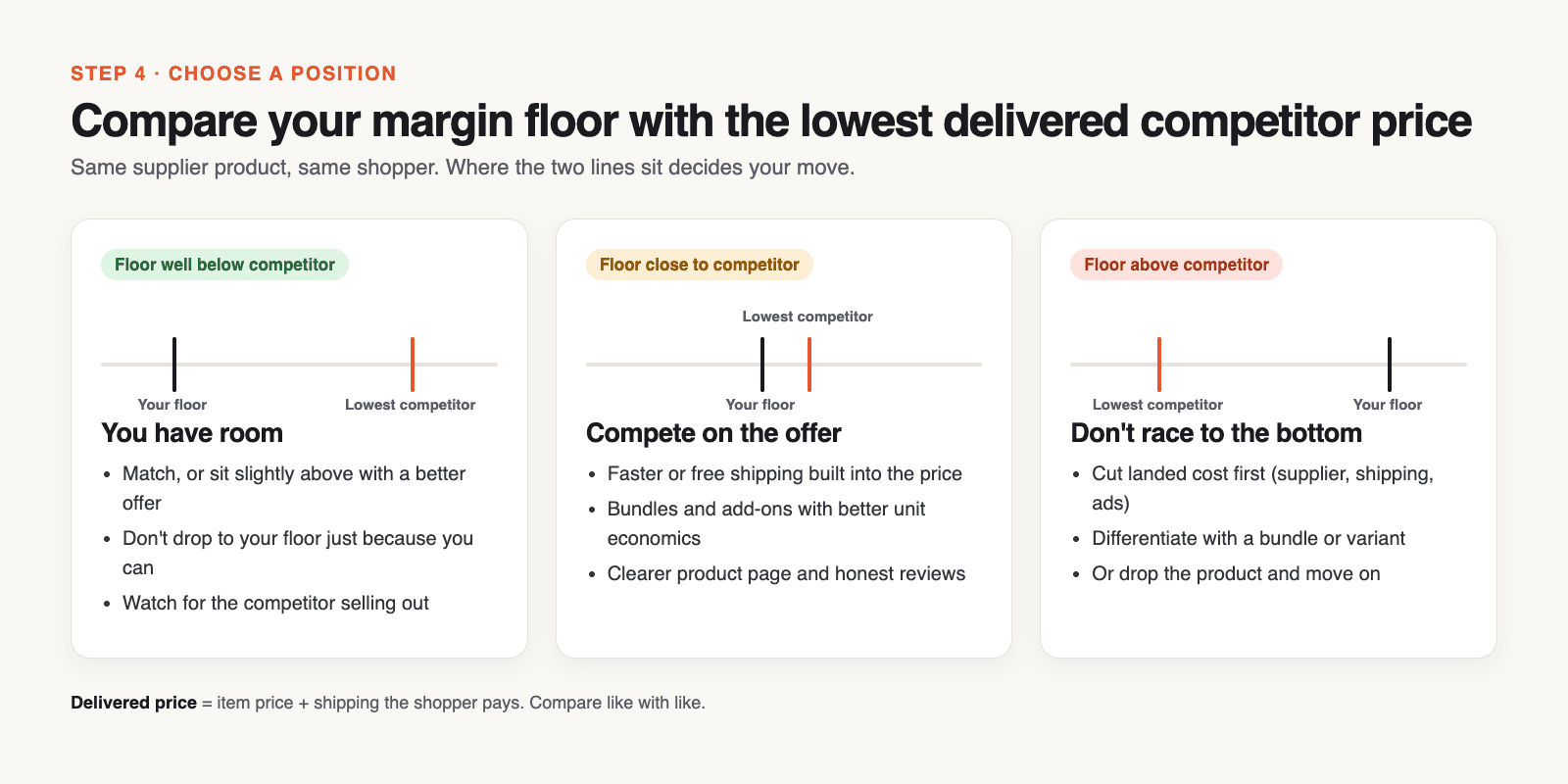
Floor well below the lowest competitor: you have room. Matching the cheapest store is an option, but not the only one. You can sit a little above it if your offer is visibly better: faster shipping, a clearer product page, a longer return window you can actually honour. Don't cut down to your floor just because the maths allows it. Other stores can cut too, and a price war on an identical product lowers the price for everyone.
Floor close to the lowest competitor: compete on the offer, not the price. Price is roughly level, so the offer decides it. Build shipping into the price and show "free shipping". Add a bundle or accessory. Answer the product questions competitors leave open. Show trust signals honestly (more on that below).
Floor above the lowest competitor: don't race to the bottom. In the hypothetical example, the floor is $29.32. If the cheapest store delivers the same lamp for $27.99, matching it loses money on every order. Before reacting, check the cut is real and lasting; our guide to price undercutting covers how to verify it and the responses available. Your options, in order:
- Cut your cost per order. Ad cost is usually the biggest lever. If better targeting or creative brought CPA from $8.00 to $6.00, the floor would fall to ($19.30 + $6.00) ÷ 0.931 = $27.18. At $27.99 you'd clear about $6.76 per order.
- Change the product. Offer a bundle, a different variant or a kit, so you are no longer selling the identical item at a worse price.
- Drop it. Some products don't work for you at current costs. Finding that out before you spend on ads is cheaper than finding out after.
Step 5: Pricing tactics that don't erode your margin
These help you compete without simply cutting price. Run each one through your floor calculation first.
Bundles and multi-packs. A bundle spreads the ad cost across more product. In the hypothetical lamp example, a two-pack at $49.99 (product $18.80, combined shipping $4.80, fees $1.75, refund allowance $2.00, ad cost $8.00) leaves about $14.64 per order, compared with $8.96 for a single lamp at $32.50. The ad cost is paid once. Bundles also give shoppers a listing they can't compare line-for-line with other stores.
Free-shipping thresholds. If shipping is a separate charge, a threshold just above your main product's price can lift order value. Check that the orders it produces still clear your floor once you absorb the shipping.
Charm pricing (with caveats). Prices ending in .99 or .95 are common, and many stores use them. The evidence on how much they help is mixed and depends on the product and the audience, so treat charm pricing as something to test, not a rule. Don't let a .99 ending take you below your floor.
Compare-at prices, used honestly. Shopify's sale pricing feature lets you show a compare-at price next to the selling price, and most themes cross it out. Use it only for a price you genuinely charged. The FTC's Guides Against Deceptive Pricing treat an inflated "was" price, set only to make the discount look bigger, as deceptive.
What is a good dropshipping profit margin?
You will see plenty of confident "ideal" margin figures online, usually with no data behind them. Actual dropshipping margins vary a lot by niche, price point, ad channel and supplier, so a single target number tells you little about your store. Answer these questions instead:
- Is contribution per order positive after ads? Gross margin before ads is the most misleading figure in dropshipping. Use the Step 1 table.
- Does it survive a bad week? Raise ad cost per order by 25% in the calculator. If the product goes negative, the margin is too thin to rely on.
- Does total contribution cover your overheads? Multiply contribution per order by realistic monthly orders and compare it with your fixed costs.
- Is your price within reach of the lowest delivered competitor? A healthy margin at a price nobody pays is not a margin.
If all four hold, your dropshipping profit margin is workable, whatever percentage it comes to. If one fails, you know which lever to work on: cost, price, offer or product choice.
Keep it current: watch competitor prices and stock
A dropshipping pricing strategy goes stale quickly. Competitors change prices, run sales, sell out and restock, and your own ad costs shift week to week. Three triggers matter most:
| When | What to do |
|---|---|
| Your CPA changes meaningfully | Recalculate your margin floor. |
| A competitor undercuts you | Compare their new price with your floor, then choose a Step 4 position. Don't react on reflex. |
| A competitor goes out of stock, or restocks | While the cheapest store can't ship, you may be the lowest available option, so review price and ad spend. When they restock, recheck your position. |
Re-check delivered prices weekly, or more often for products you advertise heavily. The competitor price monitoring guide covers cadence and alert thresholds in depth. The spreadsheet from Step 3 and a calendar reminder work for a handful of products. At a few dozen it gets tedious, and out-of-stock windows are easy to miss with weekly checks.
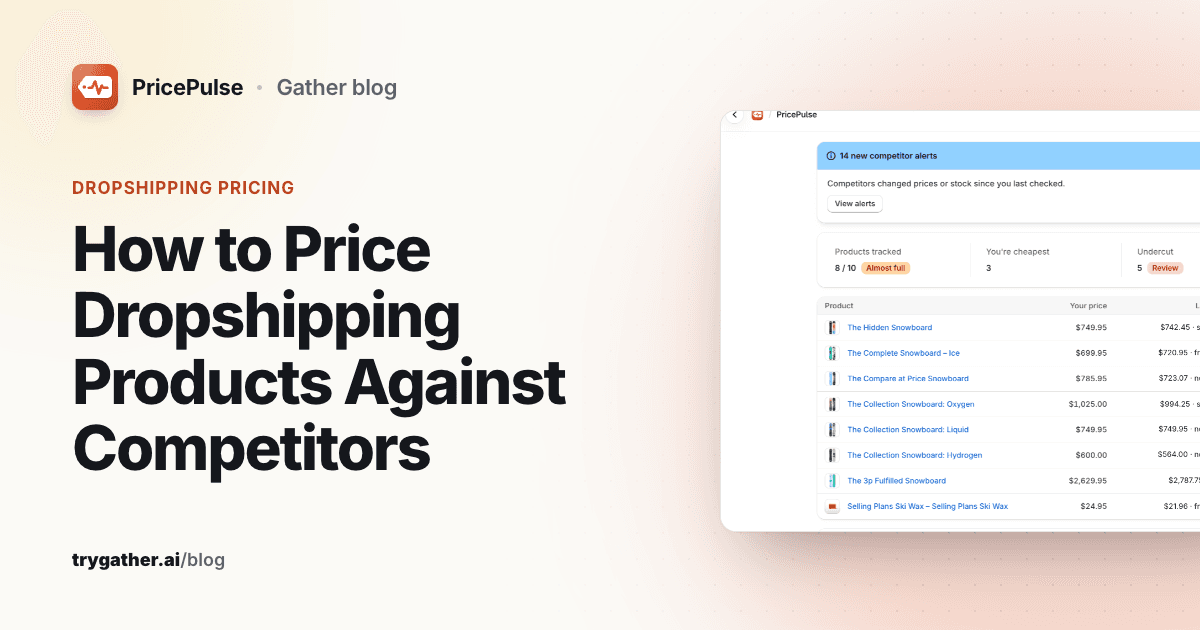
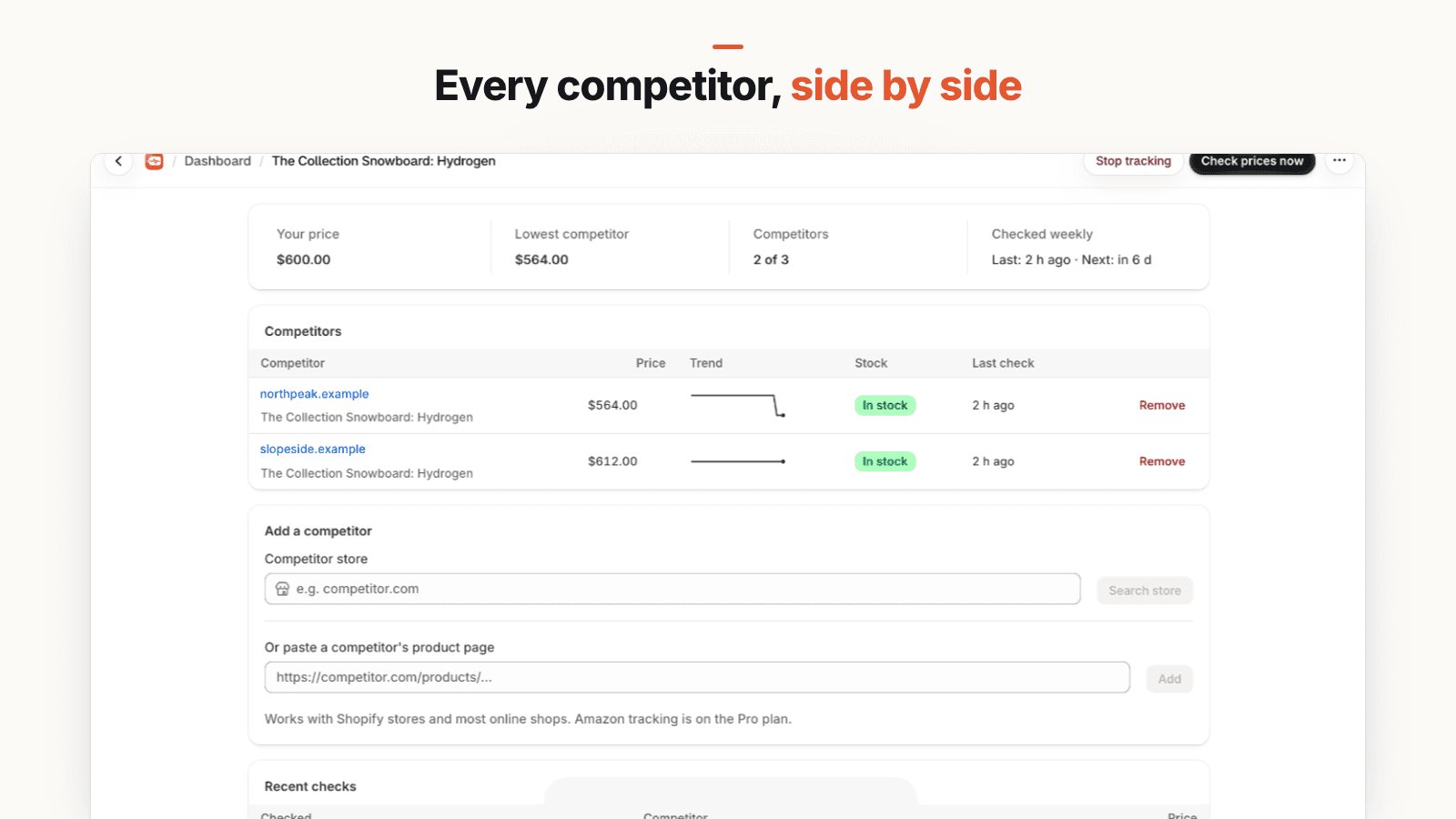
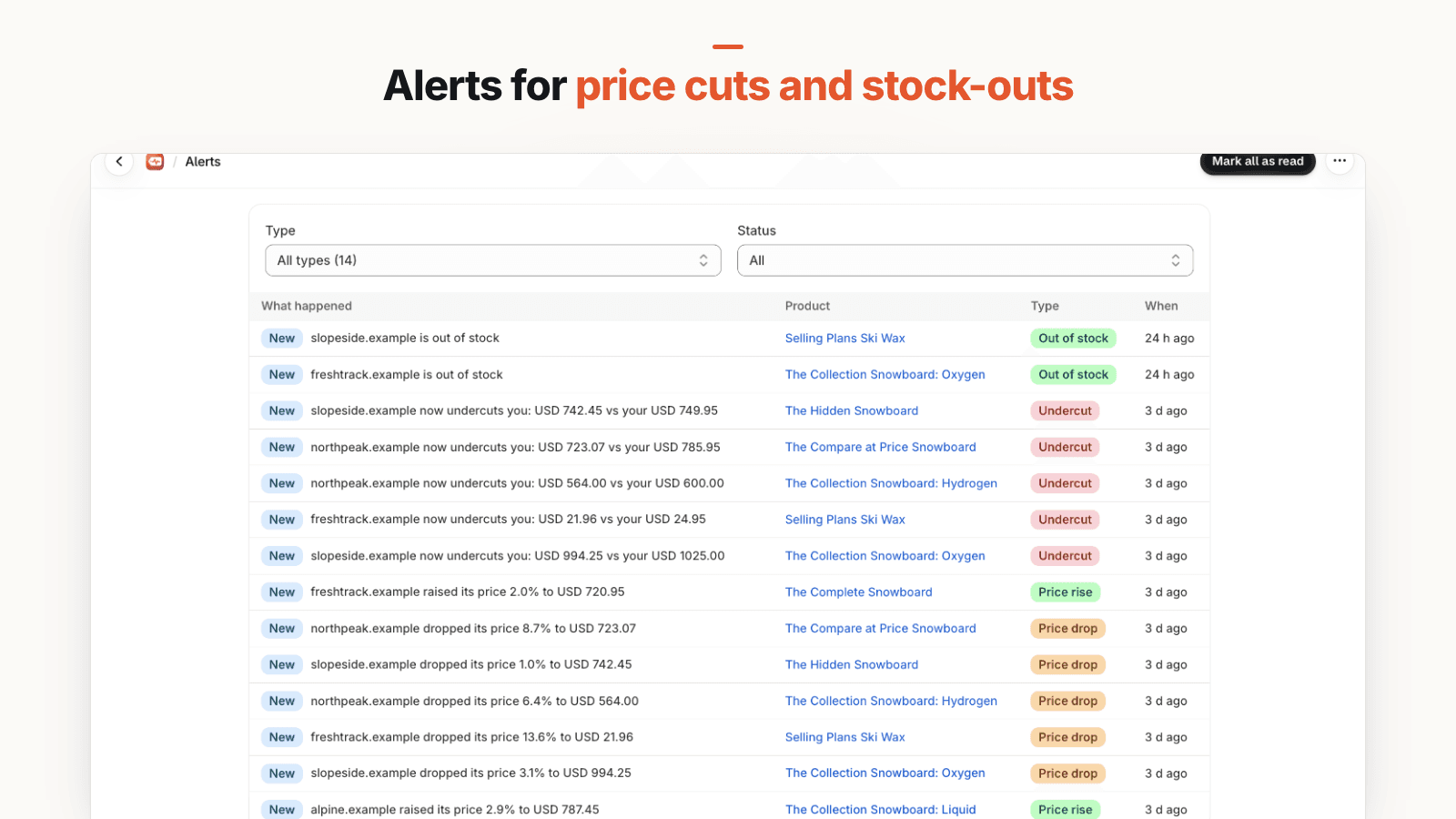
If you'd rather automate the checking, our app PricePulse is one option. You add a competitor's product link, or enter a rival Shopify store and pick the matching product from its catalog, so you confirm every match yourself. It checks those pages on a schedule and shows your price next to the lowest competitor with the gap in percent. It alerts you when a competitor drops or raises a price, undercuts you, runs out of stock or comes back in stock, and it keeps a price history. You can set a minimum change so small moves don't alert you. It is read-only and never changes your prices, so the Step 4 decision stays yours. It tracks product price and stock, not shipping fees, so keep an eye on competitors' shipping yourself.
PricePulse is new. The free plan covers 10 products with weekly checks. Paid plans check more often and add email alerts, and tracking Amazon listings needs the Pro plan; Shopify stores and most other online shops work on every plan.
For deciding how to respond when a rival goes below you, see what to do about price undercutting.
Related: build trust for dropshipped products, honestly
When your price sits a little above the cheapest store, trust often decides the sale, and a new store has little of it. Reviews help, but only honest ones. The FTC's rule on fake reviews and testimonials bans fabricated reviews and reviews that misrepresent who wrote them. Our guide to the FTC fake reviews rule explains what it means for a Shopify store.
One legitimate option for dropshippers is showing reviews that buyers left on the supplier listing you actually source from, clearly labelled with where they came from, and only when it is the identical product. Our guide to social proof for a new Shopify store covers that alongside other approaches. Gather Reviews is our app for doing it: every imported review carries its source label, and the storefront block states that the rating is the average of the imported reviews, not a rating of your store.
Frequently asked questions
What is a good profit margin for dropshipping?
No single percentage holds across niches, ad channels and price points, so a target number on its own tells you little. A more useful test is in dollars: decide the smallest contribution per order that makes a product worth your ad budget and attention, then use that as the minimum contribution in your floor price. Revisit it as your volume grows, since fixed overheads spread over more orders.
Should I just multiply my supplier cost by 2 or 3?
Use a multiplier only to shortlist products. It is a quick way to discard items with no room at all, but it says nothing about ad cost, fees, refunds or what other stores charge for the same item, so never publish a multiplier price without running the full cost and competitor checks.
Do I have to be the cheapest store selling a dropshipped product?
No. Shoppers weigh more than price: delivery time, return terms, how clear the product page is, and whether they trust the store. Being slightly above the cheapest store can work if those are visibly better. Being far above rarely does for an identical item, and pricing below your floor never does.
How do I compare competitor prices in another currency?
Convert to your selling currency at a current rate and compare delivered prices, then treat small gaps with caution, because exchange rates move and the shopper's card may add its own conversion fee. If you sell in several currencies, also check how your store rounds converted prices, so the price shoppers actually see still clears your floor.
Should I include VAT or sales tax in my pricing calculation?
It depends on how tax is shown where you sell. In the US, sales tax is usually added at checkout, so it is not part of your price. Where consumer prices are shown tax-inclusive, as in the EU, UK and Australia, the VAT or GST you owe comes out of the displayed price, so deduct it before calculating contribution. Check the rules for each market you sell into.