Free calculator · Runs in your browser
Shopify profit margin calculator
Find your real profit per order after Shopify's card fees, shipping, ads, returns and your share of the plan and apps, and the price you'd need for the margin you want.
- Profit per order
- $8.51
- Profit margin
- 21.3%
- Markup on product cost
- 185.7%
- Break-even ROAS
- 2.42×Max ad spend per order $16.51
- Price for a 25% margin
- $42.16Same costs and discount
| Revenue | $40.00 |
| Product cost | −$14.00 |
| Shipping and packaging | −$6.50 |
| Payment processing (2.9% + $0.30) | −$1.46 |
| Returns and refunds (3%) | −$1.20 |
| Ad spend | −$8.00 |
| Shopify plan and apps ($99/mo ÷ 300 orders) | −$0.33 |
| Profit per order | $8.51 |
Default fees are Shopify's US online rates as listed on its pricing page on Sep 26, 2026. Rates differ by country, card type and contract, so check your own under Settings → Payments. Taxes aren't included.
Shopify fees built into the calculator
US rates for online payments, from Shopify's pricing page as listed on Sep 26, 2026. Plan prices are for monthly billing; paying yearly costs less.
| Plan | Monthly price | Standard card | Premium card | International card | Third-party provider fee |
|---|---|---|---|---|---|
| Basic | $39 | 2.9% + 30¢ | 3.5% + 30¢ | 3.9% + 30¢ | 2% |
| Grow | $105 | 2.7% + 30¢ | 3.3% + 30¢ | 3.7% + 30¢ | 1% |
| Advanced | $399 | 2.5% + 30¢ | 3.1% + 30¢ | 3.5% + 30¢ | 0.6% |
| Plus | $2,300 (starting) | 2.25% + 30¢ | 2.95% + 30¢ | 3.25% + 30¢ | 0.2% |
Worked example: the default numbers
A $40 product that costs $14 from the supplier, $6.50 to ship and pack, $8 of ads per order and 3% refunds, on the Basic plan with a standard card, with $39 for the plan and $60 of apps a month spread across 300 orders:
- Payment processing is 2.9% of $40 plus 30¢, or $1.46. Refunds cost $1.20. The plan and apps come to 33¢ an order.
- Profit is $8.51 per order, a 21.3% margin, even though the markup on product cost is 185.7%.
- Before ads the order contributes $16.51, so the break-even ROAS is 40 ÷ 16.51 = 2.42×. Spend more than $16.51 on ads per order and you lose money on it.
- For a 25% margin with the same costs, the price would need to be $42.16. Before raising it, check where competitors sit with our competitor price check, and see our guide to announcing a price increase.
When the margin is too thin
- Raise the order value, not only the price. Bundles and free-shipping thresholds spread the fixed 30¢ card fee, packaging and ad cost over more revenue.
- Cut the ad cost per order. It is often the largest line after product cost. A lower cost per purchase does more for margin than most supplier negotiations.
- Price against the market, not just your costs. If competitors sell the same item for more, you may have room to raise your price. If they sell it for less, a price rise won't fix the margin; our guide to pricing dropshipping products covers setting a floor.
Questions
How do I calculate profit margin on Shopify?
Take what the customer pays, subtract product cost, shipping and packaging, payment processing, refunds, ad spend and your share of monthly costs such as the Shopify plan and apps. Divide what's left by what the customer paid. The calculator above does this per order.
What's the difference between margin and markup?
Markup compares your price with your product cost; margin compares your profit with your price. A $14 item sold for $40 has a 185.7% markup on product cost, but after fees, shipping, ads and returns the profit margin in the example above is 21.3%. A high markup doesn't guarantee a healthy margin.
Does Shopify charge a transaction fee?
With Shopify Payments you pay the card rate for your plan and no separate Shopify transaction fee. With a third-party payment provider, Shopify adds a transaction fee on top of the provider's own fee: 2% on Basic, 1% on Grow, 0.6% on Advanced and 0.2% on Plus, as listed on Shopify's US pricing page on Sep 26, 2026.
What is break-even ROAS?
Return on ad spend (revenue ÷ ad spend) at which an order makes zero profit. If your break-even ROAS is 2.42×, each $1 of ads must bring in at least $2.42 of revenue. The calculator also shows the most you can spend on ads per order before losing money.
What is a good profit margin for a Shopify store?
It depends on your category, average order value and how much you rely on paid ads, so there is no single benchmark worth quoting. A practical test: the margin should still be positive after a realistic ad cost and a few percent of refunds. If it only works with zero ad spend, the price or the costs need to change.
Are these fees right outside the US?
No. The defaults are Shopify's US online rates. Rates differ by country and card type, so edit the fee fields with the rates in your Shopify admin under Settings, then Payments.
From the blog
Pricing guides that use these numbers.
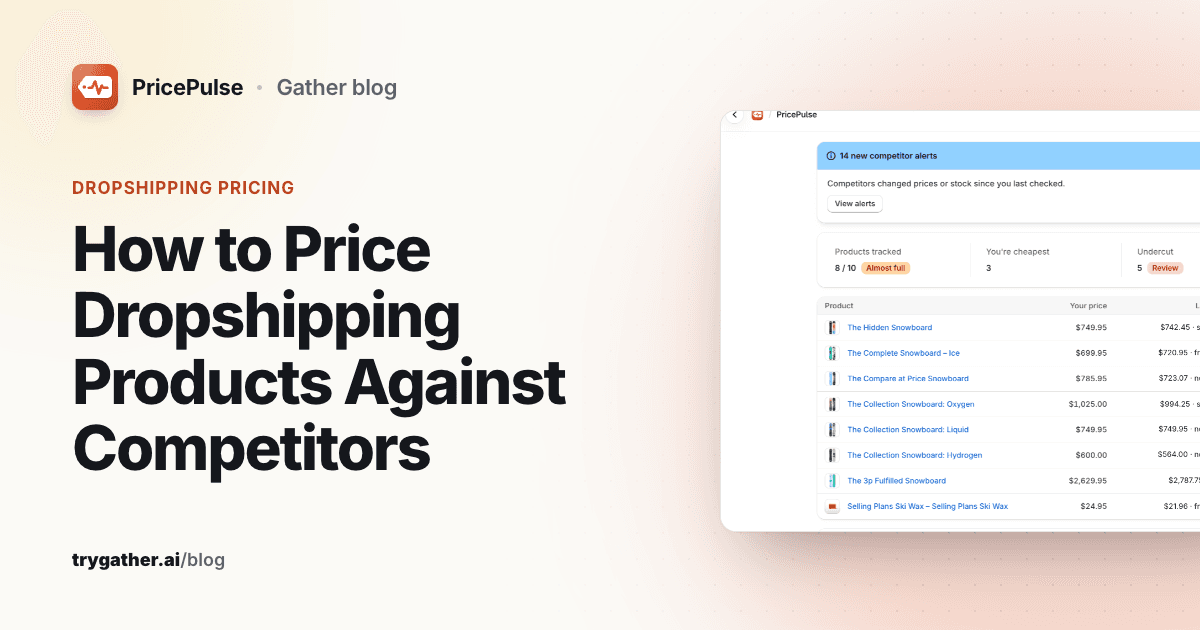
How to Price Dropshipping Products Against Competitors
How to price dropshipping products: work out your true cost per order, set a margin floor, then position against stores selling the same item. Free calculator.
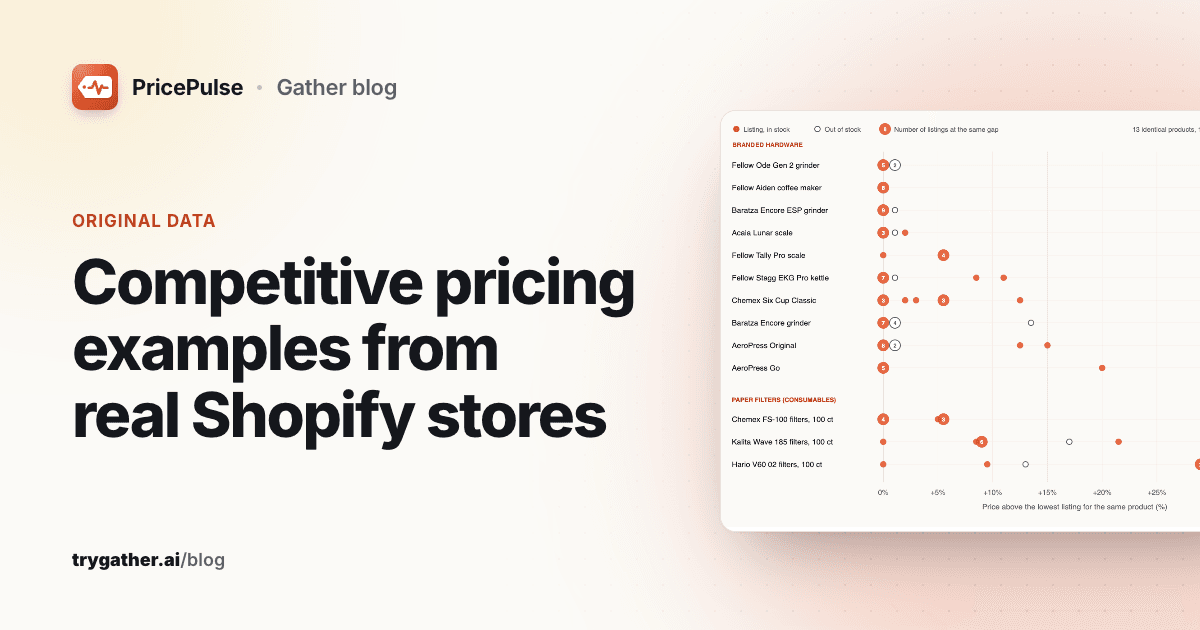
Competitive Pricing Examples From Real Shopify Stores
Competitive pricing examples from 109 listings of 13 identical products at 26 Shopify stores, with the margin math for pricing below, at or above market.
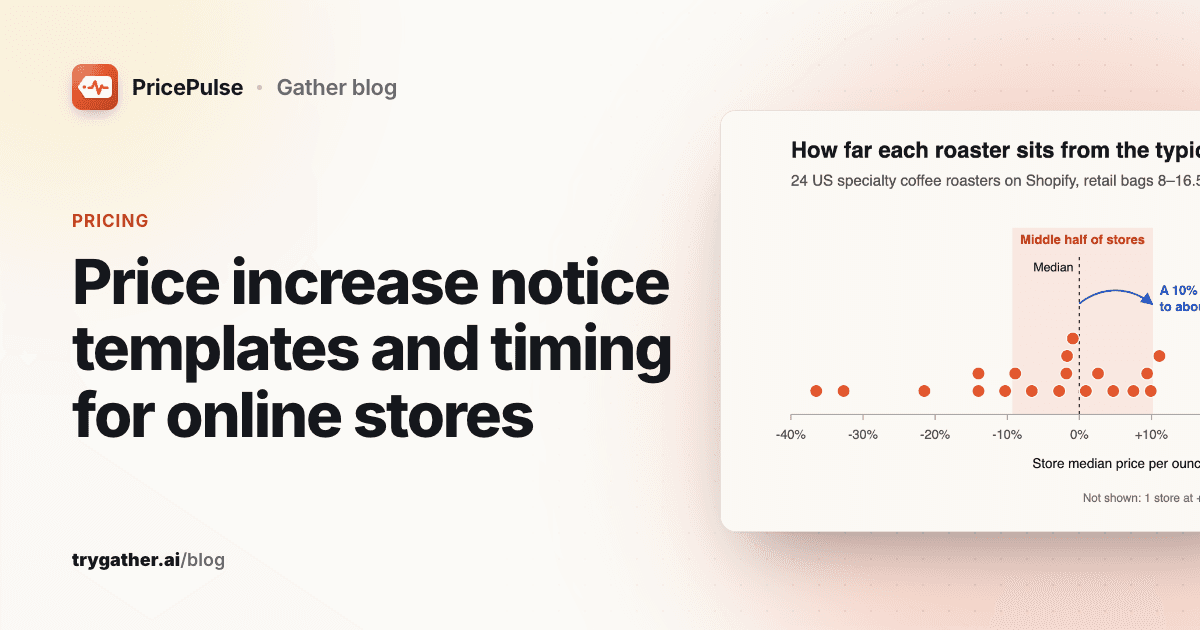
Price Increase Notice Templates and Timing for Online Stores
Who needs a price increase notice, how much to raise, and five copy-ready templates for subscribers, wholesale buyers and shoppers, with real price data.