Price Undercutting: What to Do When a Rival Cuts Prices
A price undercutting playbook for online stores: verify the rival's price, check your margin floor, pick a response and stay out of a price war.
Price undercutting is when a competitor sells the same product for less than you, so price-sensitive shoppers buy from them instead. If it has just happened to you, don't cut your price yet. Check that it is the identical product at a real, in-stock price, work out whether matching keeps you above your margin floor, and then pick one of five responses: hold, match on selected products, bundle, reposition, or compete on service and shipping. This guide covers each step, with example numbers, plus how to avoid a price war and when low pricing becomes a legal issue.
What price undercutting is (and what it isn't)
Undercutting is a deliberate, sustained lower price on a product that shoppers see as interchangeable with yours. The key words are sustained and interchangeable. A lot of what looks like undercutting on first glance isn't:
- A dated sale. A rival's weekend promotion or seasonal event is a temporary price, not a new baseline. It ends on its own.
- A stockout. Some stores leave a low price on a product they can't ship. A price on a sold-out page costs you nothing, because nobody can buy it.
- A shipping trick. A lower item price with higher shipping, or free shipping only above a threshold, may land at the same total as yours or above it.
- A gated price. Prices shown only to members, app users, subscribers or with a checkout code aren't what most shoppers pay.
- A different product. Older model, smaller size, refurbished, grey-market import, missing accessories, a different bundle. The listing title may match while the product doesn't.
Treat any of these as a real undercut and you give up margin to fight a price nobody could actually buy.
First 24 hours: verify before you react
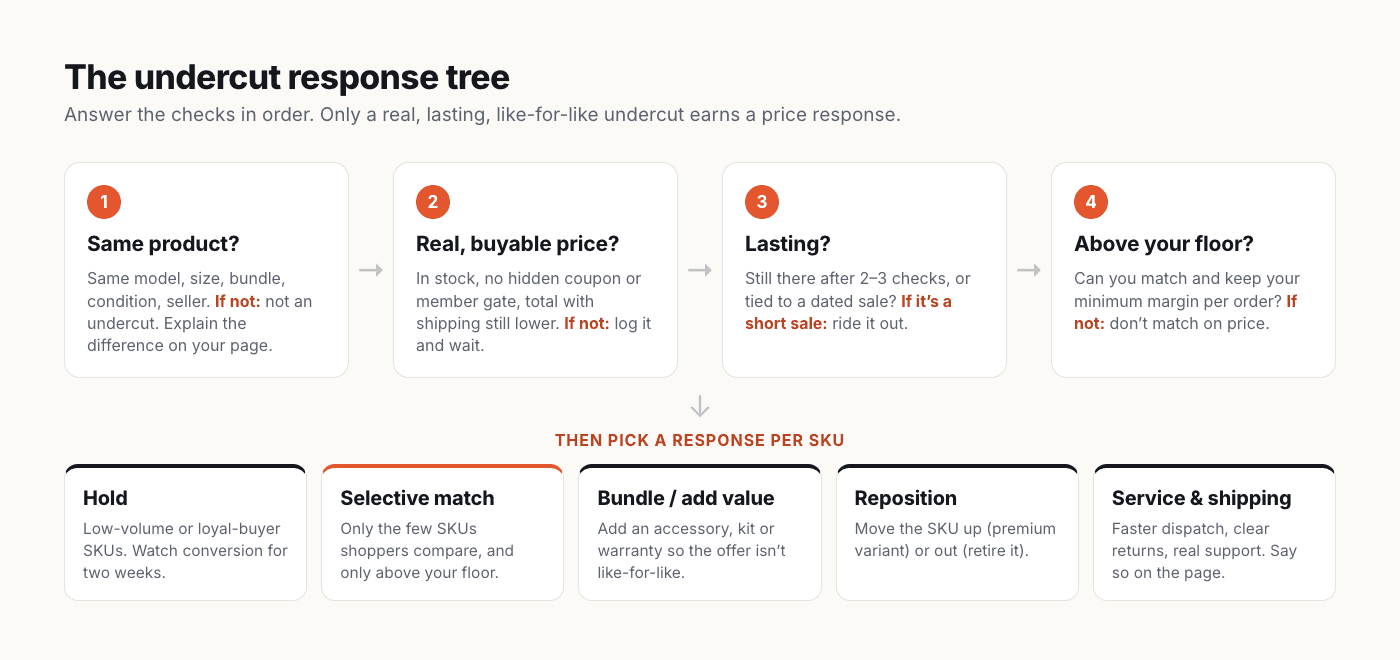
When you spot a lower price, or an alert tells you about one, run through this checklist before touching your own price.
- Is it the identical product? Compare model number, variant, size, pack quantity, condition and what's in the box. For branded goods, check the seller is an authorised retailer if that matters in your category.
- Is the price live and buyable? Add it to the cart. Confirm the price holds at checkout and isn't tied to a code, membership or first-order discount.
- Is it in stock? Look for "sold out", "pre-order", long dispatch times or a variant that can't be selected.
- Is the total landed price still lower than yours? Add shipping to your customer's region and any fees. Compare total to total, not item to item.
- Is it lasting? Check again after a day or two. If it's tied to a dated promotion, note the end date.
If the answer to any of the first four is no, it isn't an undercut. Log it and move on. If the only open question is the fifth, wait for a second or third reading before you act. Most short promotions resolve themselves inside that window.
Know your floor: can you even afford to match?
Before you decide how to respond, you need one number: the lowest price at which a sale still earns the margin you need. Call it your floor. Below it, matching loses money on every order no matter how many extra orders it brings.
Here is a worked example. All numbers are illustrative; use your own costs.
| Per order | At your current price | If you match the rival |
|---|---|---|
| Selling price | 48.00 | 42.00 |
| Product cost, landed (item + inbound freight) | 22.00 | 22.00 |
| Payment processing (example: 3% + 0.30) | 1.74 | 1.56 |
| Shipping you subsidise | 5.00 | 5.00 |
| Packaging | 1.00 | 1.00 |
| Ad spend per order | 8.00 | 8.00 |
| Contribution per order | 10.26 | 4.44 |
A 12.5% price cut removes 57% of the contribution on each order. To earn the same total, you'd need about 2.3 times as many orders (10.26 / 4.44). Be honest about whether a lower price would more than double sales of this product.
To find the floor, decide the minimum contribution you'll accept per order, then solve for price. If that minimum is 6.00 in this example:
price × (1 − 0.03) − 0.30 − 22 − 5 − 1 − 8 = 6.00, so the floor is about 43.61.
The rival's 42.00 sits below that floor. Matching isn't an option for this product, so the choice is between the non-price responses below. If you dropship, your cost stack looks different (supplier price, supplier shipping, longer delivery times). Our guide on how to price dropshipping products walks through building that stack.
Five responses to price undercutting
Once a real, lasting undercut passes the checks, pick a response per product, not for the whole catalog. Different products deserve different answers.
1. Hold your price
Holding is the right default more often than it feels. It works when the product has low volume, when your buyers come back for reasons other than price (they trust your shop, your advice, your returns), or when the rival's price is below your floor anyway. Watch the product's conversion rate for a couple of weeks. If it barely moves, the undercut isn't costing you much and you've kept your margin.
2. Match selectively
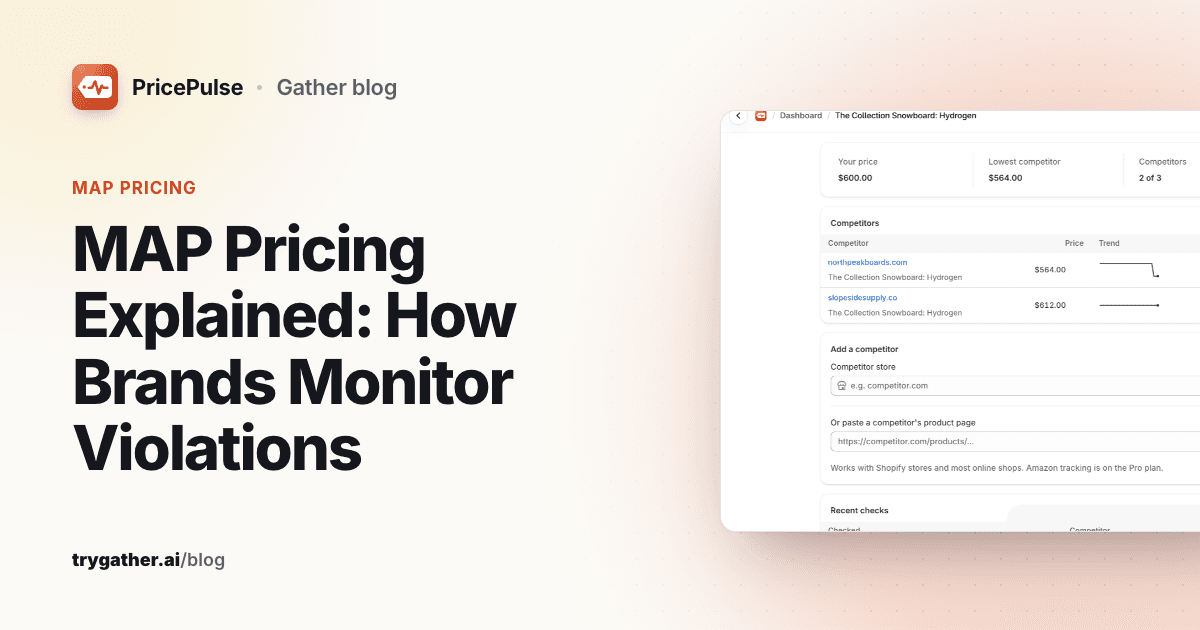
A price matching strategy doesn't have to mean matching everything. Match only on the handful of products shoppers actually compare across stores, usually well-known branded items with an obvious model number, and only where the match stays above your floor. Keep the rest of the catalog where it is. If you sell brands with a minimum advertised price policy, check it before you drop an advertised price; our MAP pricing guide explains how those policies work.
If you do change a price, be careful with sale styling. Shopify lets you show a compare-at price next to the sale price. Only use one if it's a price you actually charged, not an inflated reference number.
3. Bundle or add value
An undercut only works when the offers are like-for-like. Change the offer and the comparison breaks. Pair the product with an accessory, a refill, a kit or an extended guarantee. Shopify supports product bundles through a bundles app, and describes them as a way to add curation and value, which is exactly the point here. A bundle priced a little above the rival's single item can be the better deal for the shopper and still clear your floor.
4. Reposition the product
Some products become commodities you can't win on. Two ways out: move up, by featuring a premium variant, better material or the newer model the rival doesn't stock, or move out, by selling through remaining inventory and not reordering. Freeing up ad spend and shelf space for products where you have an edge is a legitimate response to undercutting.
5. Compete on service and shipping
Price is one part of what the shopper pays for. Faster dispatch, a clear returns policy, real product advice, reliable tracking and responsive support are all reasons people pay a bit more. They only count if the shopper can see them, so put dispatch times, returns terms and support details on the product page, close to the price.
How price wars start, and how to avoid one
A price war is a cycle of competitors cutting prices in response to each other: you cut, they cut back, you cut again. After a few rounds both sellers are pricing well below where either wanted to be, sometimes below cost, and neither gains share because each cut is matched. It usually starts with one undercut met by a reflexive match.
The usual causes:
- Automated "beat the lowest price" rules. Two stores both set to undercut the lowest competitor by a cent will ratchet each other down within hours.
- Matching the whole catalog. A blanket match turns one rival's promotion into a margin cut on every product.
- Reacting to readings, not trends. Matching a one-day promotion signals that you'll follow every cut.
- Fighting from the weaker cost position. If the rival buys cheaper than you, a price fight is one they can outlast.
Signs you're already in a price war
- A rival's price on the same product has changed several times in a short period, and each change followed one of yours.
- Your price and theirs are both lower than they were a month ago, and neither of you is selling noticeably more.
- You are making price changes because of a competitor's price rather than your own costs, stock or demand.
- Your automated rules are hitting their minimum price.
Undercutting on Amazon and other marketplaces
On a marketplace, several sellers often list the same product on one page, so undercutting is more direct. Amazon describes its Featured Offer (formerly the Buy Box) as the offer shown with Add to Cart and Buy Now, and says featured offers are "commonly at or below the lowest priced alternatives", with delivery speed, customer experience and stock also counting. Amazon's Automate Pricing tool changes prices according to rules you choose and lets you set a minimum price. When two sellers both run "match or beat the lowest price" rules, each change triggers the other's, and prices step down until someone reaches their minimum. That minimum is your floor. Set it from your real costs, not from the rival's price. The same logic applies to repricing tools on eBay and other marketplaces.
How to avoid a price war in practice
- Set a floor per product and never go below it, manually or in any automated rule.
- Respond per product, not across the catalog.
- Wait for a trend. Two or three readings, or the end of a dated promotion.
- Prefer non-price responses (bundle, service, reposition) where the product allows.
- Don't coordinate with competitors. It's tempting to message a rival and suggest you both stop cutting. Don't. The FTC's guidance on price fixing says antitrust laws generally require each company to set its prices on its own, and notes that even publicly inviting a rival to end a price war or raise prices can raise concerns. Set your prices independently and let your own decisions do the signalling.
Is undercutting prices illegal?
In almost all cases, no. Pricing below a competitor is ordinary competition. The FTC's page on predatory or below-cost pricing answers the question directly: can prices be "too low"? "The short answer is yes, but not very often."
According to that guidance, pricing below your own costs is not a violation "unless it is part of a strategy to eliminate competitors, and when that strategy has a dangerous probability of creating a monopoly" so the discounting firm can raise prices later and recoup its losses. The FTC calls these cases rare and notes that courts, including the Supreme Court, have been skeptical of predatory pricing claims. In a market with many sellers, which describes most online product categories, one store is unlikely to drive out enough rivals to dominate.
A few related points worth knowing:
- Agreements are the real risk. Price fixing, covered in the section above, is treated far more seriously than one store's low prices.
- Supplier policies aren't laws. A brand's MAP policy can cost you your account if you advertise below it, even though advertising a low price isn't illegal in itself.
- Local rules vary. Some US states have their own below-cost sales laws. Wisconsin's Unfair Sales Act (Wis. Stat. § 100.30), for example, restricts selling merchandise below cost, with exceptions that include a price set in good faith to meet a competitor's existing price. Coverage and exceptions differ from state to state, and rules outside the US differ again.
Set up undercut and stock alerts so you react with data
Everything above depends on knowing when a rival's price changes, whether it lasts, and whether they still have stock. You can do this by hand: keep a spreadsheet of competitor product URLs for your most-compared products, check them on a fixed day each week, and log price, stock and shipping. It's free and works well for a dozen products. It stops working once you have dozens of products or need to know within a day.
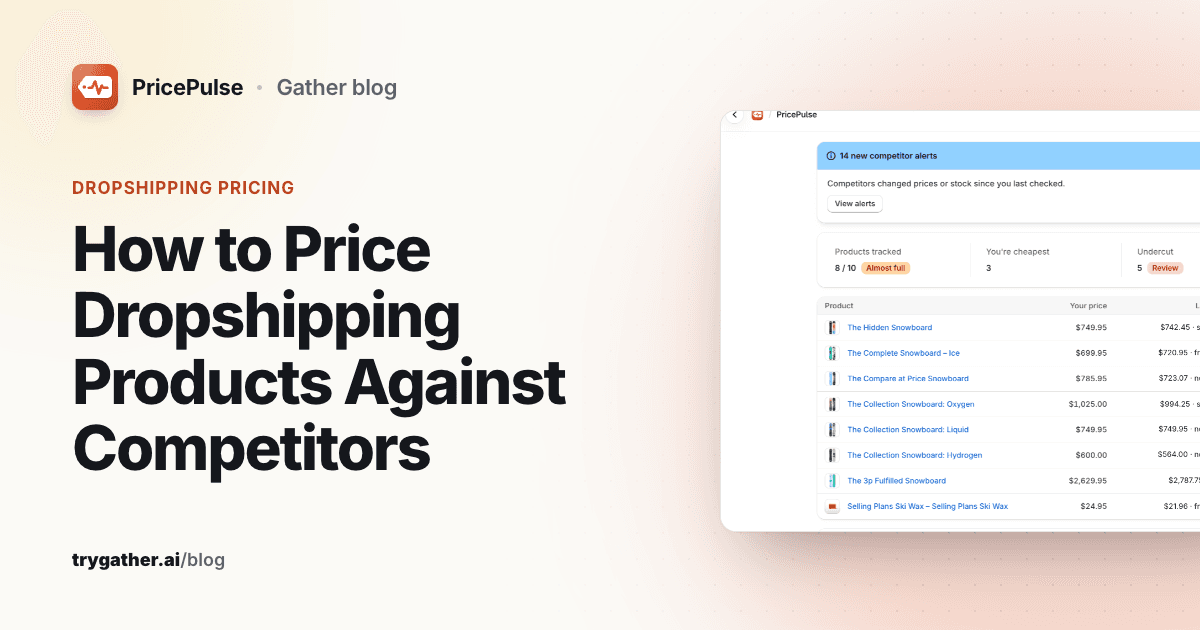
That's the gap PricePulse, our new Shopify app, is built for. You add a competitor's product link, or enter a rival Shopify store and pick the matching product from its catalog, and it checks those pages on a schedule (weekly on the free plan, up to every 6 hours on higher plans). It shows your price next to the lowest competitor and keeps every reading in price history, which is what you need for step 5 of the verification checklist.
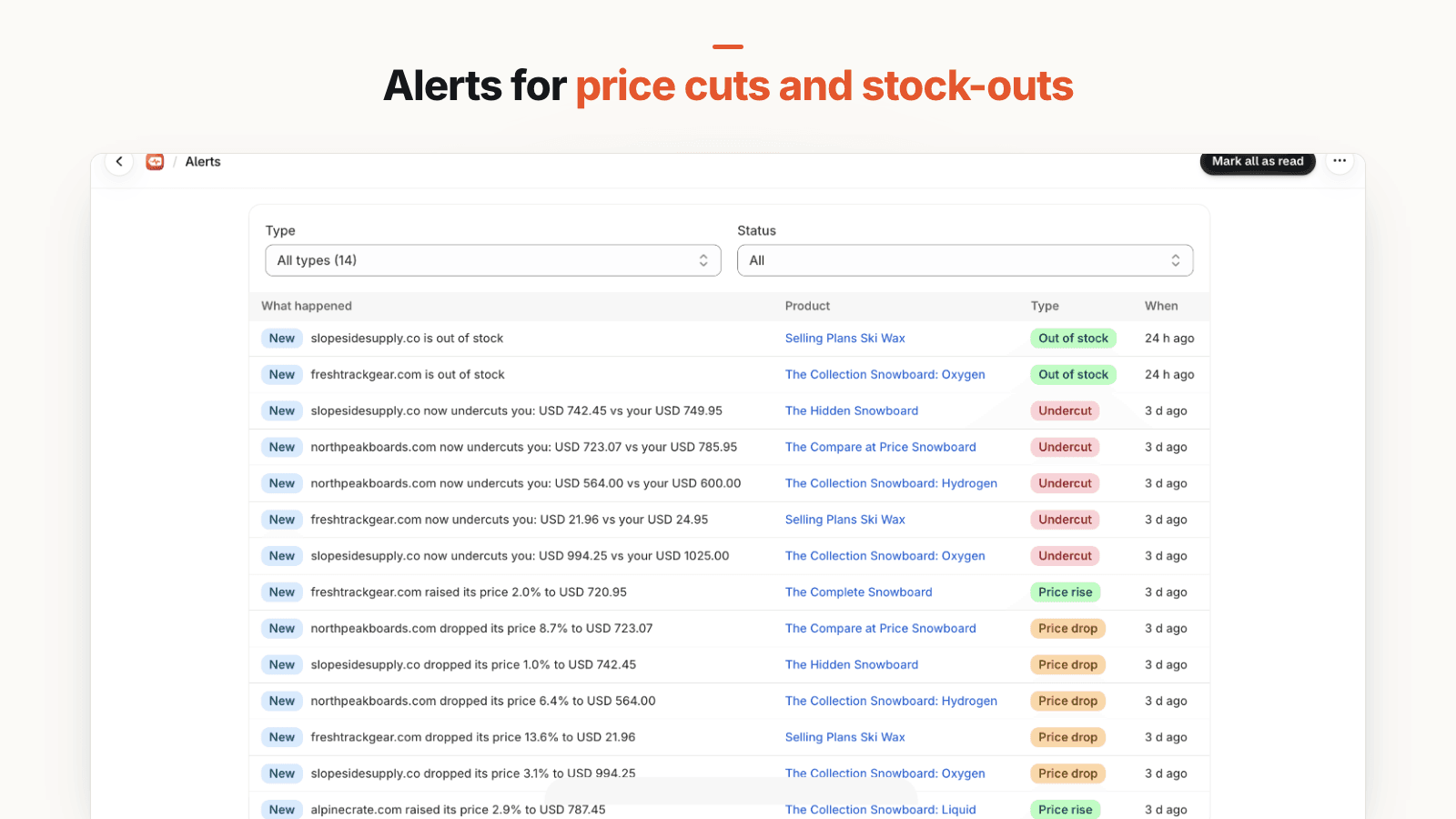
The alerts map onto the checklist:
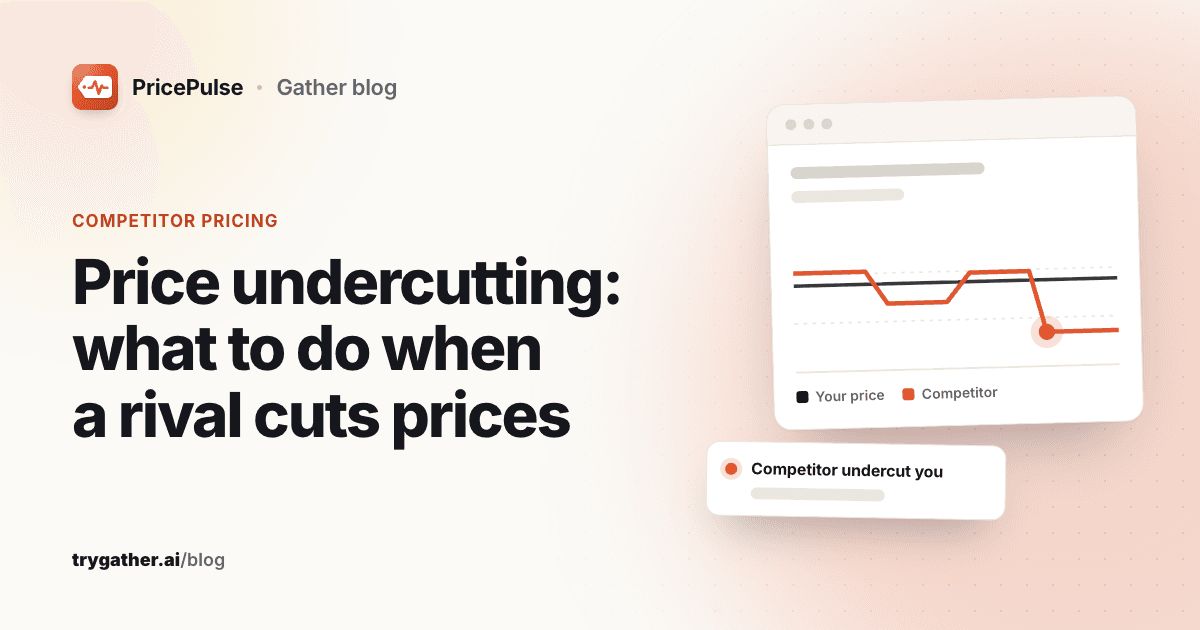
- Undercut fires when a competitor's price drops from at or above yours to below it. It doesn't fire every time a cheaper rival changes price, and the same minimum-change threshold applies.
- Price drop and price rise also respect that threshold, a minimum percentage change you set, so small movements don't reach you.
- Out of stock and back in stock always alert. A rival selling out is the moment to hold your price rather than cut it, and back in stock tells you when that pressure returns.
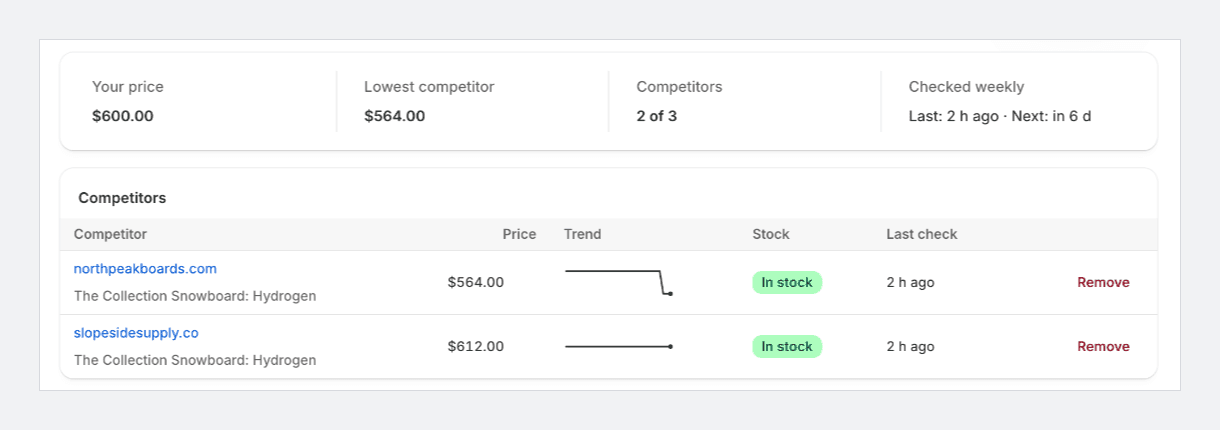
PricePulse is read-only: it never changes your prices, so every response in this guide stays your decision. It reads the listed product price and stock, so when an alert comes in, still check shipping and any checkout-only codes by hand before you act. Email alert digests are on paid plans; in-app alerts are on every plan.
For a broader look at the manual and automated options, including what to track and how often, see our guide on how to monitor competitor prices.
Frequently asked questions
What does undercutting mean in business?
Undercutting means selling the same product, or one shoppers treat as the same, for less than a competitor so that price-sensitive buyers switch to you. In ecommerce it usually shows up as a rival listing an identical item a few percent below your price.
Is undercutting prices illegal?
Usually not. Setting your own prices lower than a competitor is normal competition. The FTC explains that below-cost pricing only becomes an antitrust problem when it is part of a strategy to eliminate rivals with a dangerous probability of creating a monopoly that lets the firm raise prices later, and says such cases are rare. Agreeing with competitors on prices is a different matter and is generally illegal. This is general information, not legal advice.
What is a price war?
A price war is a run of repeated price cuts between competitors, each responding to the other, until prices sit well below where either seller wanted them. Automated repricing rules such as 'always beat the lowest price by one cent' can start one within hours.
Should I match a competitor's price?
Only after checking that it is the identical product, that the lower price is real and in stock, that it has lasted more than a check or two, and that matching still leaves you above your margin floor. Even then, match selectively on the few products shoppers actually compare rather than across the catalog.