Competitive Pricing Examples From Real Shopify Stores
Competitive pricing examples from 109 listings of 13 identical products at 26 Shopify stores, with the margin math for pricing below, at or above market.
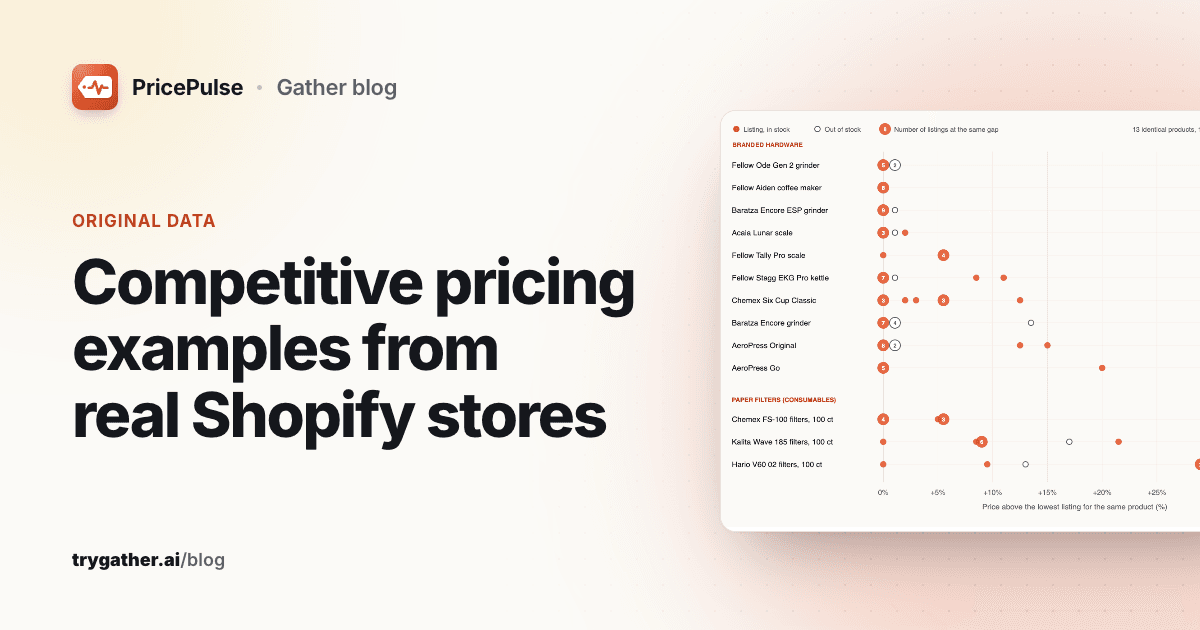
Competitive pricing means setting your price against what other stores charge for the identical item: below, level, above, or below cost as a loss leader. The competitive pricing examples here come from 13 identical coffee-gear products we checked across 26 US Shopify stores on 27 Sep 2026: on branded hardware nearly every store charged the same price, while the same box of paper filters varied by up to 32%. Which kind of product you sell decides which position is open to you.
What a competitive price means in practice
"Market rate" is too vague to price against. For each product, you need two numbers for the identical item (same model, colour, size and pack count):
- The lowest in-stock price. This is what a shopper who searches and compares will find.
- The most common price. This is what most shoppers will see, and usually where the brand's suggested price sits.
If the two are the same number, the whole market sits on one price. If the lowest is well below the most common, one seller has chosen a different position, and you can decide whether to follow it.
Choosing your position on your own is ordinary competition. The FTC puts it plainly: each company may charge the same price as its competitors "as long as the decision was not based on any agreement or coordination with a competitor." Watch and match all you like; never agree prices with a rival.
The snapshot: 13 identical products across 26 Shopify stores
| Product (exact variant) | Type | Stores | Lowest | Most common (stores) | Highest | Spread |
|---|---|---|---|---|---|---|
| Fellow Ode Brew Grinder Gen 2, Matte Black | Hardware | 7 | $399.95 | $399.95 (7) | $399.95 | 0% |
| Fellow Aiden coffee maker, Matte Black | Hardware | 8 | $399.95 | $399.95 (7) | $400.00 | 0% |
| Baratza Encore ESP grinder, Black | Hardware | 10 | $199.95 | $199.95 (9) | $200.00 | 0% |
| Acaia Lunar scale, Black | Hardware | 5 | $250.00 | $250.00 (4) | $255.00 | 2.0% |
| Fellow Tally Pro scale, Black | Hardware | 5 | $189.95 | $199.95 (4) | $199.95 | 5.3% |
| Fellow Stagg EKG Pro kettle, Matte Black | Hardware | 10 | $179.95 | $179.95 (8) | $199.95 | 11.1% |
| Chemex Six Cup Classic | Hardware | 9 | $47.00 | $49.50 (3) | $52.95 | 12.7% |
| Baratza Encore grinder, Black | Hardware | 12 | $149.95 | $149.95 (9) | $170.00 | 13.4% |
| AeroPress Original | Hardware | 12 | $39.95 | $39.95 (8) | $46.00 | 15.1% |
| AeroPress Go | Hardware | 6 | $49.95 | $49.95 (5) | $59.95 | 20.0% |
| Chemex FS-100 filters, 100 ct | Filters | 8 | $10.45 | $10.45 (4) | $11.00 | 5.3% |
| Kalita Wave 185 filters, 100 ct | Filters | 10 | $11.95 | $13.00 (5) | $14.50 | 21.3% |
| Hario V60 02 filters, white, 100 ct | Filters | 7 | $7.76 | $10.00 / $10.25 (2 each) | $10.25 | 32.1% |
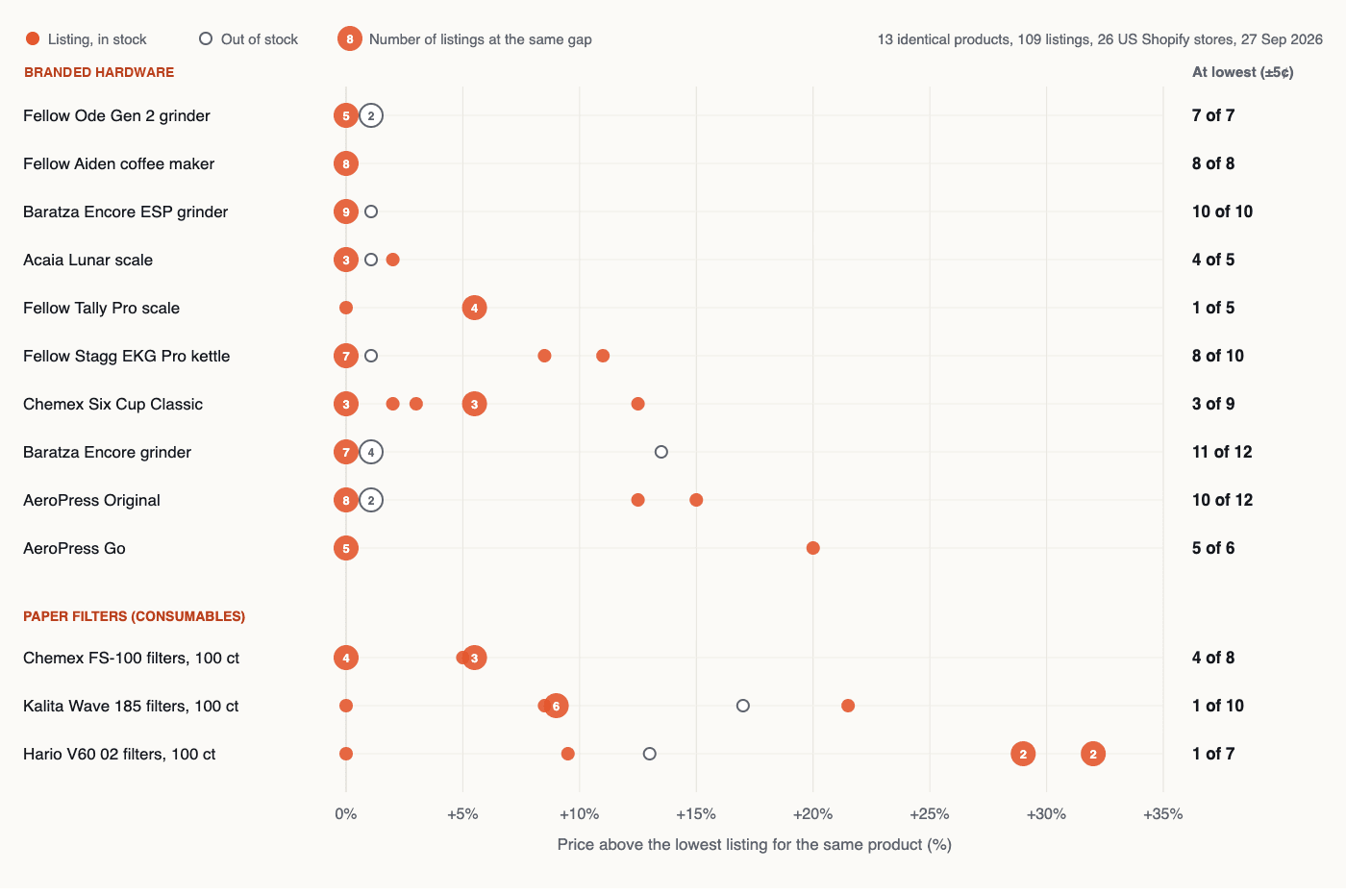
Spread = how far the highest price sits above the lowest, in percent. The chart shows every listing as its gap above the lowest price for that product.
Download the data: matched listings (CSV), product summary (CSV), full method (TXT).
Across all 109 listings, 66 were at exactly the lowest price for their product, and 73 were within 5 cents of it. That total hides two very different markets.
Finding 1: on branded hardware, price is not where you compete
Of the 84 hardware listings, 60 were at exactly the lowest price and 67 were within 5 cents. The median gap was 0%.
- Fellow Ode Gen 2: 7 of 7 stores at $399.95.
- Fellow Aiden: 7 of 8 at $399.95, one at $400.00.
- Baratza Encore ESP: 9 of 10 at $199.95, one at $200.00.
- Fellow Stagg EKG Pro: 8 of 10 at $179.95. The highest was $199.95, at the kitchenware retailer, 11.1% above.
Fellow publishes its MAP policy: the minimum advertised price "will correspond with the Fellow 'MSRP'", and violations "may result in the suspension or termination of a Resellers' right to sell Fellow products." A reseller can price above that number but not advertise below it. Advertise below it and you risk losing the account, so on these products undercutting is off the table for anyone who wants to keep selling them. The Baratza and Acaia clusters look the same from outside; we did not check those brands' policies.
The few sellers above the cluster were charging more for the same box. The kitchenware retailer was the highest seller on the kettle and on the Chemex Six Cup, and sat at the common price on the other four products it listed. Our read: its shoppers are buying pans and knives, not comparing kettle prices across coffee sites.
For what a MAP policy lets you do and how brands enforce one, see our MAP pricing guide.
Finding 2: on consumables, stores really do choose a position
The three filter products tell the opposite story. Only 6 of 25 filter listings sat at the lowest price, and the median gap was 8.8%.
- Hario V60 02 filters, 100 ct: $7.76 to $10.25, a 32.1% spread. The top price, $10.25, came from a brand store and a roaster.
- Kalita Wave 185 filters, 100 ct: $11.95 to $14.50. Five of 10 stores sat at $13.00, one at $11.95, and a tail ran to $14.50 (+21.3%).
- Chemex FS-100 filters: tight by comparison, $10.45 to $11.00 (+5.3%).
One specialist gear retailer held the lowest price on all three filter products. Roasters did the opposite: 15 of their 16 filter listings were above the lowest price. The likely reason: their shoppers come for beans, and filters ride along in the same cart.
Hardware with no single dominant price sits in between. The Chemex Six Cup Classic ran from $47.00 to $52.95 (+12.7%), and its most common price, $49.50, covered only 3 of 9 stores. AeroPress Original had 8 of 12 stores at $39.95, with a gear retailer at $44.99 and a roaster at $46.00.
Finding 3: the premiums were buyable, and compare-at prices ran from $170 to $400 on a $149.95 grinder
A high price on a sold-out page costs a rival nothing, so we checked. Of the 32 listings priced more than 5% above the lowest, only 3 were out of stock. The premiums were real, buyable prices. Overall, 14 of 109 listings were out of stock at the time of the check.
Compare-at ("was") prices varied far more than selling prices. The Baratza Encore in Black sold for $149.95 or $150.00 at 11 of 12 stores. Three of those stores showed compare-at prices, of $170, $195 and $400.
Two rules apply to your own compare-at prices, whatever other stores do:
- Shopify shows a sale only when compare-at is higher than price, and checkout shows only the sale price. One store in the data had a compare-at below its selling price; Shopify simply doesn't show that as a sale.
- A former price has to be real. The FTC's guide on former price comparisons, 16 CFR 233.1, says it should be "the actual, bona fide price at which the article was offered to the public on a regular basis for a reasonably substantial period of time." Check each "was" price on your store against that before you put a strike-through on it.
This snapshot doesn't assess any store's pricing; we don't know their price histories. General information, not legal advice.
Example 1: price below market (V60 filters)
All costs in these examples are hypothetical. We don't know any store's wholesale cost and none of these numbers is a real dealer margin. Market prices come from the snapshot.
Say your landed cost for a 100-count box of V60 02 filters is $5.00 (hypothetical) and you sell it at $9.50.
| Your price now | Match the $7.76 low | |
|---|---|---|
| Price | $9.50 | $7.76 |
| Hypothetical cost | $5.00 | $5.00 |
| Profit per box | $4.50 | $2.76 |
| Margin | 47.4% | 35.6% |
To earn the same gross profit at $7.76, you need to sell 4.50 ÷ 2.76 − 1 = 63% more boxes. The general formula:
Extra units needed = (current price − cost) ÷ (new price − cost) − 1
A below-market price is worth it when all three are true: the item carries no brand minimum, shoppers repurchase it often (so the first order has follow-on value), and you are the low-cost seller, so a rival can't cut below you without losing money first. If you are responding to a competitor who went low first, our guide to price undercutting covers what to check before you follow.
Example 2: price at market (Stagg EKG Pro under a MAP)
Hypothetical cost $108, price $179.95: a 40.0% margin. The brand's policy sets the lowest price you can advertise, and eight of 10 stores are already on it.
So the competition moves to things a shopper can see besides price:
- Stock. One of the eight at $179.95 was sold out on the day we checked. If yours ships today, say so on the page.
- Delivery speed and cost. Shipping wasn't in our data, and it is where two identical prices stop being identical.
Be careful with the usual "add a bundle" advice here. Fellow's policy lists advertising "a discount or incentive to combine the sale of other products or services" with its products as a violation, alongside phrases like "Lowest Price Guarantee". Read the brand's policy before advertising any bundle, gift or guarantee on a MAP product.
Example 3: price at a premium (Kalita filters, AeroPress Original)
Kalita Wave 185 filters, hypothetical cost $7.50:
| Price | Where it sits | Margin | Extra units needed if you drop to $11.95 |
|---|---|---|---|
| $14.50 | Observed high | 48.3% | 57% |
| $13.00 | Most common | 42.3% | 24% |
| $11.95 | Observed low | 37.2% | none |
AeroPress Original at a hypothetical $44.00 (not an observed price), against the $39.95 most stores charge, with a hypothetical cost of $24: 45.5% margin versus 39.9% at $39.95. Matching the market would need about 25% more units to earn the same gross profit.
A premium holds only when something else justifies it. At least one of these should be true:
- You are in stock when others are not (check this every week, not once).
- You deliver faster or cheaper to your main market.
- You bundle the item with your own goods, on a product with no MAP restriction on bundles.
- Your buyers are already on your site for something else, as a roaster's likely are when it sells filters beside beans.
If none is true, the premium is just a gap that comparing shoppers will notice. If reaching it means raising a price existing customers already pay, our price increase notice guide covers timing and wording.
Example 4: loss leader
Costs aren't public, so the snapshot can't show whether any store sold below cost. The numbers here are invented.
A roaster sells a box of filters at $4.00. Landed cost is $5.00, plus $2.00 of shipping it absorbs on a small first order: a $3.00 loss on every box. The aim is the follow-on purchase, a bag of beans with $6.00 gross profit.
Break-even attach rate = loss per lead item ÷ profit per follow-on purchase = 3.00 ÷ 6.00 = 50%
Half of the filter buyers must go on to buy beans just to break even. If your order data says 30%, every box loses money.
Loss leaders work only on items shoppers compare and repurchase, and only when you can measure the attach rate. Never advertise below a brand's minimum advertised price, whatever the attach rate. Never go below cost without a measured attach rate. The worksheet's floor check flags both.
Decision table: which position for which product
| Position | Use when | Avoid when | Check first | Watch after |
|---|---|---|---|---|
| Below market | No brand minimum; spread over 10%; frequent repurchase; your cost is lower than rivals' | A MAP applies, or the extra-units figure is higher than any lift you expect | Lowest in-stock price, your landed cost, extra units needed | Units sold vs the extra-units target, and whether rivals cut too |
| At market | The brand has a MAP and the most common price covers two-thirds or more of stores, or you can't beat the lowest seller's cost | You can't make your margin floor at that price | Brand policy, most common price, your margin | Competitor stock-outs, shipping offers |
| Premium | Spread over 10% and at least one of the Example 3 conditions holds | Shoppers compare this exact item across sites, and you have no edge beyond price | Whether the lowest seller is in stock; delivery times | Conversion rate on the product page, cart abandonment |
| Loss leader | A compared, repurchased item with a measurable follow-on purchase | Branded goods under a MAP; no attach-rate data | Break-even attach rate | Actual attach rate after 30 days |
Our rule of thumb: if the most common price covers two-thirds or more of stores and the brand has a MAP, compete on something other than price. If the spread is over 10% on an unrestricted item, pick a position on purpose and run the extra-units math before you cut. The two-thirds and 10% lines are judgement calls, not thresholds the data produced.
Two quick calls:
- A filter pack, spread 21%, no brand minimum, bought monthly by your coffee customers: premium is available if your buyers come for beans; below market only if you are the low-cost seller.
- A brewer with a 15% spread, 8 of 12 stores at the low (the AeroPress Original pattern): at market, unless the page it sits on carries an audience that doesn't comparison-shop.
Worksheet: score your own top products
Download the price position worksheet (CSV). It opens in Google Sheets or Excel with live formulas, four example rows that use labelled hypothetical costs, and ten blank rows that calculate as you fill them.
- Name the exact variant. Model, colour, size and pack count. A 40-count box is not a 100-count box.
- Enter the lowest in-stock price. Skip sold-out listings; they can't take a sale from you.
- Enter the most common price and the highest, plus the brand's minimum advertised price if there is one.
- Enter your landed cost per unit (product plus inbound freight) and your current price. If you dropship, our guide to pricing dropshipping products shows what goes into that cost.
- Read the outputs. Gap vs lowest and vs most common, your margin, margin if you match the lowest, extra units needed to keep gross profit, and a floor check that flags a price below cost or below the brand minimum. Then write down the position you chose and why.
Start with the 10 products that bring in the most revenue. For ongoing tracking of those prices, with a template and a check schedule, use our guide on how to monitor competitor prices.
Keep the numbers current with PricePulse
Our competitor pricing tools comparison has its own 27 Sep 2026 coffee-gear snapshot; it is a separate sample of stores and products, so its counts differ from these. PricePulse, our Shopify app, re-runs this check on a schedule and puts the gap on one screen. It is read-only: it never changes your prices. It has been submitted to the Shopify App Store and is awaiting review, so it isn't listed there yet.
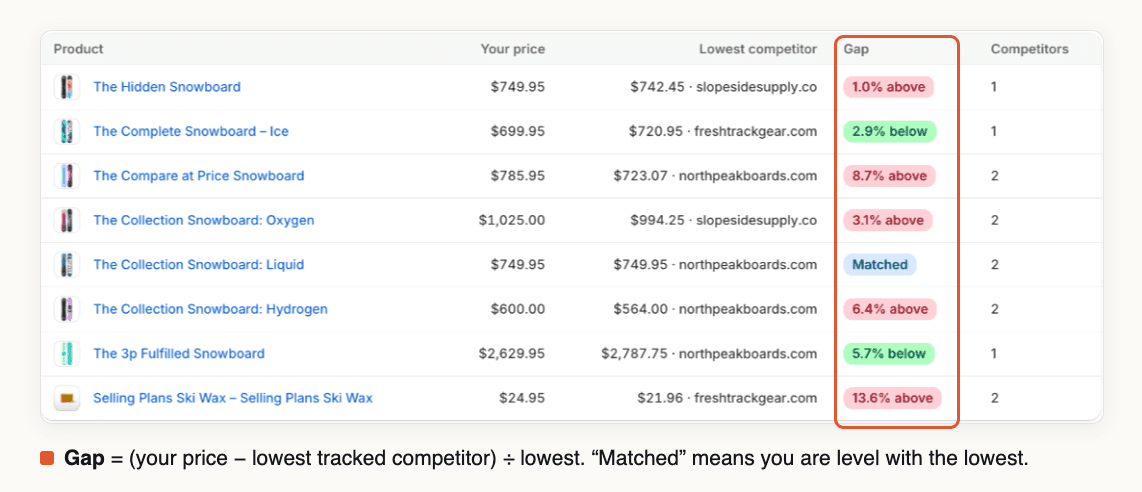
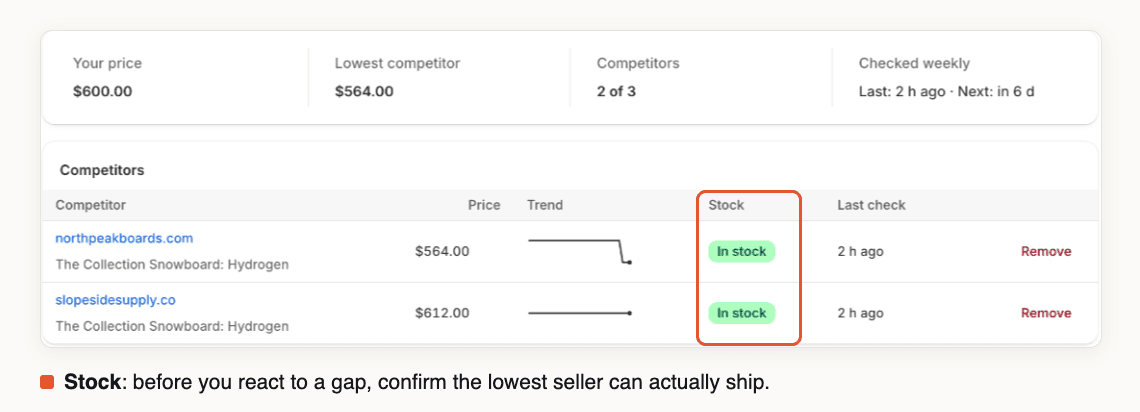
The gap is calculated against the lowest competitor you track, whether or not that competitor has stock. Before acting on it, open the product and check the Stock column.
It works with Shopify stores and most online shops, and Amazon tracking is on the Pro plan. Plans are Free (10 products, up to 3 competitors each, weekly checks), Starter at $19 a month (daily checks), Growth at $49 (every 12 hours) and Pro at $99 (every 6 hours), with a 7-day trial on paid plans. Email alert digests come with the paid plans.
Frequently asked questions
What is a competitive price?
A competitive price is one you set deliberately against what other stores charge for the identical item: the same model, variant and pack size. In practice that means knowing two numbers, the lowest in-stock price and the most common price, and choosing whether to sit below, at or above them. A price is not competitive just because it is low; it is competitive when shoppers comparing the same item have a reason to buy it from you.
What company uses competitive pricing?
In our 27 Sep 2026 snapshot of 26 US Shopify stores selling coffee equipment, specialist gear retailers listed 74% of their branded hardware (23 of 31 listings) at the lowest price for that product, while coffee roasters priced 15 of their 16 paper-filter listings above the lowest price.
Is it legal to match a competitor's prices?
In the US, generally yes. The FTC says each company is free to set its own prices and may charge the same price as its competitors, as long as the decision was not based on an agreement or coordination with a competitor. Watching public prices and deciding on your own is fine; agreeing prices with a rival is not. Brand agreements such as a minimum advertised price policy can also limit what you advertise. This is general information, not legal advice.
What is the difference between competition-based pricing and cost-plus pricing?
Cost-plus pricing starts from your cost and adds a markup. Competition-based pricing starts from what shoppers can pay elsewhere for the same item. You need both: the competitor price tells you what the market will bear, and your cost tells you whether that price still earns enough. If matching the market leaves you below your cost floor, compete on something other than price or stop selling that item.
How much should I undercut a competitor?
Work it out in units, not percent. Divide your current profit per unit by your profit per unit at the lower price and subtract one: that is how many more units you must sell just to earn the same gross profit. With a hypothetical $5.00 cost, dropping from $9.50 to $7.76 needs 63% more units. If you don't expect that lift, don't cut.