Competitor Pricing Tools Compared: Costs and Limits (2026)
15 competitor pricing tools and DIY options compared: what the limit counts, check frequency, the first tier with email alerts, and who can change prices.
Competitor pricing tools range from a free spreadsheet to quote-only enterprise platforms. Three things decide which one fits: how many competitor URLs you watch, how often they are checked, and whether the tool may change your prices or only read them. For a Shopify store watching 25 products at 3 competitors each, daily, the cheapest plan whose plan card lists alerts ranged from $8 to $199 a month across the tools below. Most of that spread comes from which tier each vendor starts alerts on.
Six kinds of competitor pricing tool
| Kind | Examples | Good at | Where it breaks |
|---|---|---|---|
| Manual or spreadsheet | Bookmarks, a sheet, IMPORTXML formulas | Under about 10 products, weekly checks, full control | Time grows with products × competitors × checks. IMPORTXML formulas break when a page layout changes. |
| Free signal | Google Merchant Center pricing report | A free benchmark for products with a GTIN | Needs a valid GTIN and does not name the competitors (Google). No alerts. |
| Generic page monitor | Visualping, PageCrawl | Any page, any layout, fast check intervals | Limits count pages and checks. It tells you a page changed, not "price fell 6% and stock ran out". |
| Read-only Shopify tracker | PricePatrol, PricePulse (ours) | Price gap and stock alerts on identical products, low entry price | Cannot act for you. Marketplace coverage varies by plan. |
| Tracker with repricing | PriceOtus, Lurk, Pricefy, Prisync, PriceMole, PriceRest | Tracking plus rules that change your prices | Needs permission to edit your products. Rules can chase a competitor down (see the repricing section). |
| Enterprise, quote only | Price2Spy, Competera | Thousands of SKUs, several markets, a pricing team | No public prices, so budgeting starts with a sales call. |
Count URLs and checks before you compare plans
Before opening a pricing page, write down three figures. Vendors count limits differently, and this is how you translate between them:
- Competitor URLs = products × competitors. 25 products at 3 competitors is 75 URLs. Page monitors limit by URLs (pages), trackers by products, and some by competitors or checks per day.
- Checks per month = URLs × checks per day × 30. 75 URLs checked daily is 2,250 checks. 150 products × 5 competitors = 750 URLs; checked twice daily, that is 750 × 2 × 30 = 45,000 checks.
- Variant slots. If the plan counts variants as products (Prisync's Shopify listing says "products/variants"), multiply by the variants you actually compare. In our sample of 34 Shopify coffee-equipment stores, the median store had 2.24 variants per product, and the median share of products with more than one variant was 48%. Tracking every variant there turns 100 slots into about 44 products (100 ÷ 2.24); divide by your own variants-per-product figure to redo it for your catalog.
The competitor pricing tool worksheet (CSV, opens in Google Sheets or Excel) does this arithmetic from your inputs, including manual hours per month, and has a blank grid for comparing plans with a "source URL and date checked" column.
Plans compared: limits, check frequency, alert tier (27 Sep 2026)
Prices are USD per month on monthly billing unless noted. "First email alerts" is the lowest tier whose plan card lists email, instant or price-change notifications.
| Tool | Entry paid plan | Limit counts | Check frequency | First email alerts | Stock | Amazon | Can change your prices | Trial / free | As listed on |
|---|---|---|---|---|---|---|---|---|---|
| Baseline | |||||||||
| Spreadsheet | $0 | Your time | When you check | None | Manual | Manual | No | n/a | n/a |
| Google Sheets IMPORTXML | $0 | One formula per URL | Recalculates hourly | None | No | No | No | n/a | |
| Free signal | |||||||||
| Merchant Center pricing report | $0 | Products with a valid GTIN | Not stated | None (a report) | No | No | No | Free | |
| Generic page monitors | |||||||||
| Visualping | Personal 1K, $14 ($120/yr) | Pages: 10 (40 on Personal 10K, $70; 500 on Business 50K, $350) | 1,000 checks/mo on Personal 1K | Free (page-change alerts) | No | n/a | No | Free plan, 5 pages | visualping.io |
| PageCrawl | Standard, $8 ($80/yr) | Pages: 100, sold in 100-page steps to 300 ($24); Enterprise from 500 pages ($30) | To every 15 min, 15,000 checks/mo per 100 pages | Free (email) | n/a | n/a | No | Free plan, 6 pages | pagecrawl.io |
| Read-only Shopify trackers | |||||||||
| PricePatrol | Premium, $4.99 | 50 competitors, 50 checks/day | 50/day; unlimited on Ultimate ($14.99) | Not listed | Not listed | Listing says yes | Not listed | Free plan | Shopify |
| PricePulse (ours) | Starter, $19 | Products: 100, 5 competitors each | Daily; 12 h on Growth ($49); 6 h on Pro ($99) | Starter (email digests); Free is in-app only | Yes | Pro ($99) | No | Free plan (10 products, weekly); 7-day trial | trygather.ai, submitted to the App Store, not listed yet |
| Trackers with repricing | |||||||||
| PriceOtus | Pro, $39 | Products: 200 (variant support from Pro Advanced, $89) | Every 12 h | Pro (instant alerts); Free has email reports | Not listed | Listing names Amazon and Google Shopping channel tracking | Yes, from Pro | Free plan; 14 days | Shopify |
| Lurk | Basic, $49 | SKUs: 250, 10 competitors each | 2x a day | Free lists "real-time price adjustment alerts" | Not listed | Any URL, per listing | Yes, every plan | Free plan; 10 days | Shopify |
| Pricefy (own site) | Starter, $49 ($37 annual) | SKUs: 100 | 2x a day | Starter | Not listed | Not on plan card (feature page lists Amazon, eBay, Google Shopping) | Pro ($99) | Free: 50 SKUs, 5 competitors | pricefy.io |
| Pricefy (Shopify listing) | Starter, $49 | SKUs: 100 | 2x a day | Pro ($99); Starter lists "Instant Reports" | Yes | Marketplace analysis from Starter | Pro ($99) | Free: 50 SKUs, 3 competitors | Shopify |
| Prisync (own site) | Professional, $99 | Products: 100 | 3x a day | Premium ($199) daily; Platinum ($399) instant | Yes | Marketplaces from Premium | Premium | 14 days, no card | prisync.com |
| Prisync (Shopify listing) | Professional, $49 | Products/variants: 100 | 3x a day | Premium ($199) daily; Platinum ($399) instant | Yes | Marketplaces from Premium | Premium | 14 days | Shopify |
| PriceMole | Starter, $99 | Products: 100 | 4x a day | Not listed on plan card | Yes | Channel tracking incl. Amazon, all plans | Yes | 14 days | Shopify |
| PriceRest | Basic, $49 | Products: 100 (variant tracking from $189) | 1x a day | Plan card lists MAP violation notifications; description mentions price-change alerts | Yes | Amazon API integration listed | Yes | 14 days | Shopify |
| Enterprise, quote only | |||||||||
| Price2Spy | Quote | Up to 10 competitors on Starter | Up to 8 checks/day on Premium | Starter daily; instant from Basic | Not listed | Marketplaces from Basic | Separate paid module | Free trial offered; length not stated on pricing page | price2spy.com |
| Competera | Quote | Not published | Not published | Not published | Not published | Not published | AI price recommendations | On request | competera.ai |
PricePatrol (launched April 2026) and PriceRest (launched July 2026) had no reviews on their listings on the day we checked, so there is less public feedback to go on for either.
The same tool, different terms depending on where you buy
Two vendors show different terms on their own site and on their Shopify App Store listing:
- Prisync Professional is $99 on prisync.com and $49 on the Shopify listing, which labels it "Exclusive for Shopify users". The Shopify listing also counts "products/variants" where the site says "products".
- Pricefy Free allows 5 competitors on pricefy.io and 3 on the Shopify listing. Price change notifications appear on Starter on the site, but on the Shopify listing the "Daily Price Change Notification" line starts at Pro.
Price2Spy publishes no prices at all. Treat any figure for it that isn't on the vendor's own page as unverified.
Rule: you are billed by the page you check out on. If you install from the Shopify App Store, read the plan card there, and screenshot it with the date.
Worked scenario: 25 products, 3 competitors, daily, with email alerts
This is a hypothetical store, priced from the dataset above: 25 products × 3 competitors = 75 competitor URLs, checked daily = 2,250 checks a month, alerts required, no repricing. "Alerts" means the plan card lists email, instant or price-change notifications, the same test as the "First email alerts" column. The tables show the cheapest plan on each tool that covers it, monthly billing.
Fits, with alerts on the plan card
| Tool | Cheapest plan that fits | Monthly | Why this plan, and the catch |
|---|---|---|---|
| PageCrawl | Standard, 100 pages | $8 ($6.67 billed $80/yr) | 75 pages fit in 100. It watches pages, not a price field, so there is no price-gap view, and its pricing page lists sites that block bots as "some sites" on Standard and "most sites" on Enterprise and Ultimate. |
| PricePulse (ours) | Starter | $19 | Free is too small (10 products, weekly) and alerts in the app only. No Amazon below Pro, no repricing. |
| PriceOtus | Pro | $39 | Free covers 5 products. Checks every 12 hours, instant alerts, repricing rules you can leave off. |
| Lurk | Basic | $49 | 250 SKUs. Repricing rules come on every plan. |
| Pricefy | Starter (site) or Pro (Shopify) | $49 or $99 | Free tracks this store daily but lists no notifications. Which tier adds them depends on the page you buy from. |
| Visualping | Business 20K | $140 | Personal 10K caps at 40 pages. |
| Prisync | Premium | $199 | Professional ($49 on Shopify, $99 on site) tracks all 75 URLs 3x a day but lists no email notifications. |
Fits on capacity; price alerts not listed on the plan card
| Tool | Cheapest plan that fits | Monthly | Why this plan, and the catch |
|---|---|---|---|
| PricePatrol | Ultimate | $14.99 | Premium caps at 50 checks a day; you need 75. |
| PriceRest | Basic | $49 | 100 products, 10 competitor sites included. The plan card lists MAP violation notifications; price-change alerts appear only in the description, so confirm what arrives on Basic during the trial. |
| PriceMole | Starter | $99 | Fits on products. |
| Price2Spy, Competera | Quote | n/a | No public prices. |
| By hand | Spreadsheet | $0 | At 1 minute per check (an assumption, time your own), 2,250 checks is 37.5 hours a month. |
Of the price trackers whose plan card lists alerts, PricePulse Starter ($19) is the lowest price for these inputs; PriceOtus Pro ($39) is next. That is a result of these particular inputs, not a general ranking. Change one input and the order changes: add Amazon and PricePulse jumps to $99; ask for repricing and it drops out.
Second scenario: 150 products × 5 competitors, twice daily. That is 750 URLs and 45,000 checks a month. Visualping's largest self-serve plan, Business 50K ($350), stops at 500 pages and 50,000 checks, so 750 pages means an Enterprise quote. PageCrawl's Standard plan tops out at 300 pages, so 750 pages means Enterprise, sold in 500-page steps: 1,000 pages is $60 a month ($50 billed annually) and moves from "some" to "most" sites that block bots. The trackers that fit are PricePatrol Ultimate ($14.99, no product cap stated, alerts not listed), PriceOtus Pro ($39, 200 products, but variant support needs Pro Advanced at $89), PricePulse Growth ($49), Lurk Basic ($49), Pricefy Pro ($99), PriceRest Professional ($189), Prisync Premium ($199) and PriceMole Professional ($249, alerts not listed on the plan card). By hand, it is 750 hours a month, which is no longer a real option.
One snapshot: 54 listings of the same coffee gear
Before paying for checks every 6 hours, look at what competitors' prices do in your category. We read the public product catalogs of 34 US Shopify stores selling specialty coffee equipment on 27 Sep 2026 (26,086 products and 79,707 variants), then found 9 identical branded products stocked by at least 4 of them: 54 listings in all. Where two prices tied for most common, we used the lower one (this affects one product, a dripper listed at $40 twice and $42 twice).
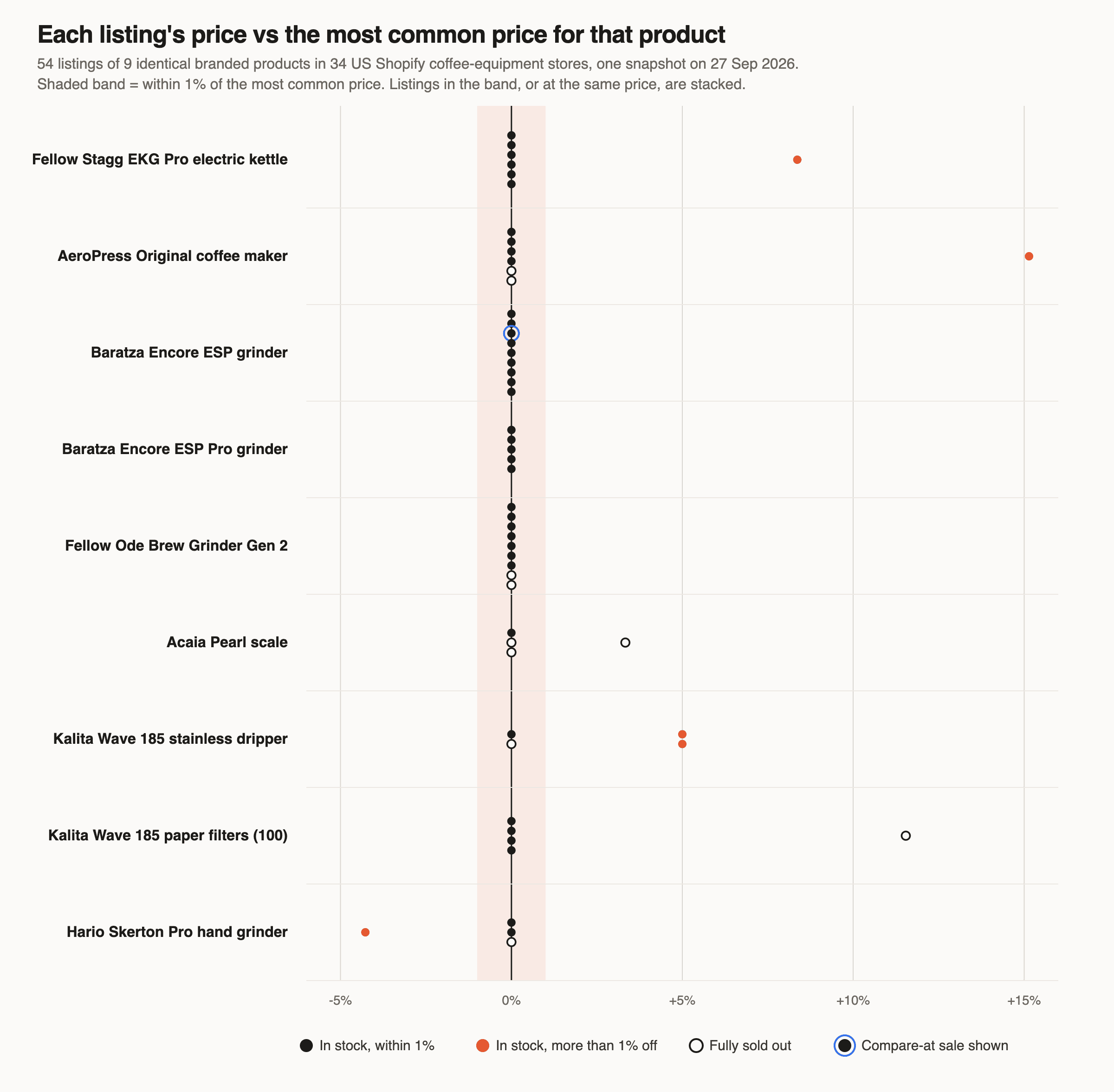
| Across 54 listings of 9 identical products | Count | Share |
|---|---|---|
| Within 1% of the most common price | 47 | 87% |
| More than 1% below it | 1 | 2% |
| More than 1% above it (up to 15.1%) | 6 | 11% |
| Fully sold out (every variant) | 10 | 19% |
| Showing a compare-at "sale" price | 1 | 2% |
Prices clustered at one common price for each product, which is consistent with brand-set pricing (see the MAP pricing guide for what that means for your own prices). In a category like this, a tracker's useful output at any moment is mostly two things: which competitor is out of stock, and the rare seller below the common price. Across the 34 stores, the median share of variants marked sold out was 24%.
What this means for buying:
- Pay for stock alerts before check frequency here. When a competitor sells out of a product you stock, that is the time to check your own inventory and ad spend on it, not your price.
- Daily is a sensible starting cadence. This is one snapshot, so it says nothing about how often prices change. Start daily, keep a log for a few weeks, and pay for faster checks only if you see moves between checks.
- Other categories behave differently. This covers US specialty coffee equipment only. Unbranded or own-label products, where sellers set their own prices, and marketplace listings where sellers reprice automatically may move more often. Run the same count on your top 10 products before you pick a tier.
Read-only or repricing?
A read-only tracker reads competitors' pages and your catalog. A repricing tool also writes to your catalog: it changes your prices by rules such as "stay 2% below the lowest competitor, never under $X". On Shopify, an app that changes prices needs permission to edit your products, and the install screen lists the permissions it asks for. PricePulse asks only to read products.
Repricing earns its keep when you have too many SKUs to review by hand, sell on marketplaces where other sellers reprice by rule, and have a minimum price set for every product. Keep rules off and act on alerts yourself when:
- you have agreed minimum advertised prices with brands. A "match the lowest" rule can follow a below-MAP seller straight down. This is not legal advice; check your agreements and the MAP pricing guide.
- two rule-based tools start following each other. Each cut triggers the other's next cut until both hit their floors. The price undercutting guide covers how to respond to a cut without starting that loop.
- your margins are thin. One rule set without a floor can sell a product below cost for a whole night.
If you do reprice, set floors per product from your landed cost, never have a rule create a compare-at "was" price you did not actually charge, and decide your prices independently. Watching public prices is ordinary market research; agreeing prices with a competitor is not.
Decision table: which kind fits how you sell
| Your situation | Start with | Budget reality (27 Sep 2026) |
|---|---|---|
| Under 10 products, or checking now and then | Spreadsheet plus Merchant Center price benchmarks if you have GTINs | $0; your time |
| A few pages in odd layouts, not all product pages | A generic page monitor (Visualping, PageCrawl) | Free to $140 depending on pages |
| Shopify store, identical products on other independent stores, you decide prices | A read-only Shopify tracker sized by URLs, with stock alerts | $15 to $49 for tens to hundreds of products |
| You need prices to change automatically | A repricing tier with margin floors: PriceOtus, Lurk, PriceRest, Pricefy Pro, Prisync Premium, PriceMole | $39 to $249 |
| Thousands of SKUs, several markets, a pricing team | Price2Spy, Prisync Platinum or Competera | $399 listed for Prisync Platinum; others on quote |
| Amazon is where you win or lose the sale | A tool with Amazon on a plan you can afford | Varies. PriceMole lists channel tracking including Amazon on all plans (from $99), Pricefy's Shopify listing puts marketplace analysis on Starter ($49), and PricePatrol, PriceOtus and PriceRest mention Amazon on their listings; Prisync starts marketplaces at Premium ($199) and PricePulse at Pro ($99). |
If you are in the last two rows, an enterprise tool or a dedicated marketplace repricer will serve you better than a small Shopify tracker, including ours.
What to test in the first 7 to 14 days
Most trials here run 7 to 14 days. Use them on the same test for every tool so the results compare:
- Add the same 5 products everywhere. Include one multi-variant product and one competitor that sells in a different currency or market.
- Compare one recorded price against the competitor's store as your shoppers see it. When we read the same 34 catalogs from a location outside the US, 4 stores returned a different currency and different prices. A tracker checking from another country can record a price your shoppers never see.
- Check the variant match. Open each competitor URL yourself and confirm the tool recorded the size, colour or pack you sell, not the cheapest variant on the page.
- Force one check (or wait for the first scheduled one) and look at how a failed read is shown. A silent blank is worse than an error you can see.
- Confirm alert delivery on your tier. Trigger or wait for one alert, and check that the email arrives, not only the in-app notice.
- Check what the counter counted. After adding 5 products, the usage meter should say 5. If it says 12, the plan counts variants.
- Screenshot the plan card and the date before you enter card details.
Where PricePulse fits (ours)
PricePulse is a read-only competitor price tracker for Shopify stores. For a competitor that also runs on Shopify, you enter its store address and PricePulse scans its catalog for products matching the ones you track; for most other online shops you paste the product page link. The products list shows your price, the lowest competitor price and the gap as a percentage, so a product priced, say, 8% above the cheapest competitor stands out without opening it. The gap is left blank when the competitor's price is in a different currency, rather than comparing EUR with USD. Alerts cover price drops, price rises, undercuts, out of stock and back in stock. Plans run from Free (10 products, weekly) to Pro $99 (2,000 products, every 6 hours, Amazon); 7-day trial on paid plans.
Its limits: it never changes your prices, it does not record shipping or compare-at prices, and your side of each comparison is the first variant of the product you add. For the full monitoring process, from choosing competitors to acting on a gap, see how to monitor competitor prices.
Method and data
- Plan data: every figure was copied from the vendor's pricing page or Shopify App Store listing on 27 Sep 2026 (tool-plans-verified-2026-09-27.csv). Where a vendor's site and its Shopify listing differ, both rows are kept.
- Coffee-equipment snapshot: we read each store's public product catalog once on 27 Sep 2026, with US market and USD settings. Stores are anonymised as S01 to S34; two very large catalogs were capped at 5,000 products, and one store pricing from a non-USD base was excluded. Identical products were matched by title rules that exclude open-box, bundles, parts and different editions; where two prices tied for most common, the lower one counts as the common price. Prices are list prices for US shoppers, excluding shipping, tax and discount codes. Files: catalog stats by store, identical products summary, listing-level observations and METHOD.txt.
- Worksheet: competitor-pricing-tool-worksheet.csv.
Frequently asked questions
What is price monitoring software?
Price monitoring software checks the product pages of stores you name on a schedule, records each competitor's price and usually stock status, and alerts you when something changes. Some tools only read prices (read-only). Others, usually on higher tiers, can also change your own prices by rules you set, which is called repricing and needs permission to edit your products.
Which competitor pricing tools send price change alerts by email?
Most do, but often not on the entry tier. On the pages we checked on 2026-09-27, Prisync lists daily email notifications from Premium ($199), Pricefy lists price change notifications on Starter ($49) on its own site but from Pro ($99) on its Shopify listing, and PricePulse (ours) sends email digests from Starter ($19). Read the plan card for the tier you are about to buy, not the feature page.
Are there free competitor price monitoring tools?
Yes, for small catalogs. A spreadsheet costs nothing. Google Merchant Center's pricing report benchmarks your price against other retailers selling the same GTIN, without naming them. Free plans we checked include Pricefy (50 SKUs, daily, no notifications), PriceOtus (5 products), Lurk (5 SKUs), PageCrawl (6 pages), Visualping (5 pages) and PricePulse (10 products, weekly, in-app alerts).
Can a competitor pricing tool change my prices automatically?
Only if it is a repricing tool and you grant it permission to edit your products. Lurk, PriceMole and PriceRest list automatic repricing on every paid Shopify plan, and PriceOtus from Pro; Pricefy from Pro and Prisync from Premium; Price2Spy sells repricing as a separate module. Read-only trackers such as PricePulse cannot change prices. If you use repricing, set a minimum price for every product before switching it on.